Spine patients pick a surgeon after months of searching and trying other care. They search their symptoms, see a physical therapist or family doctor, get imaging, then compare surgeons on Google, reviews, credentials and condition pages, often with a second opinion. Practices that explain options honestly at every stage, and answer quickly when patients reach out, win the consult.
Spine is unusual. Few patients wake up wanting surgery. They want the pain to stop, and they'll try almost anything else first. That makes the path to a spine consult longer and more research-heavy than most surgical specialties, and it means your marketing has to meet patients long before they're ready to book.
What does the spine surgery patient journey look like?
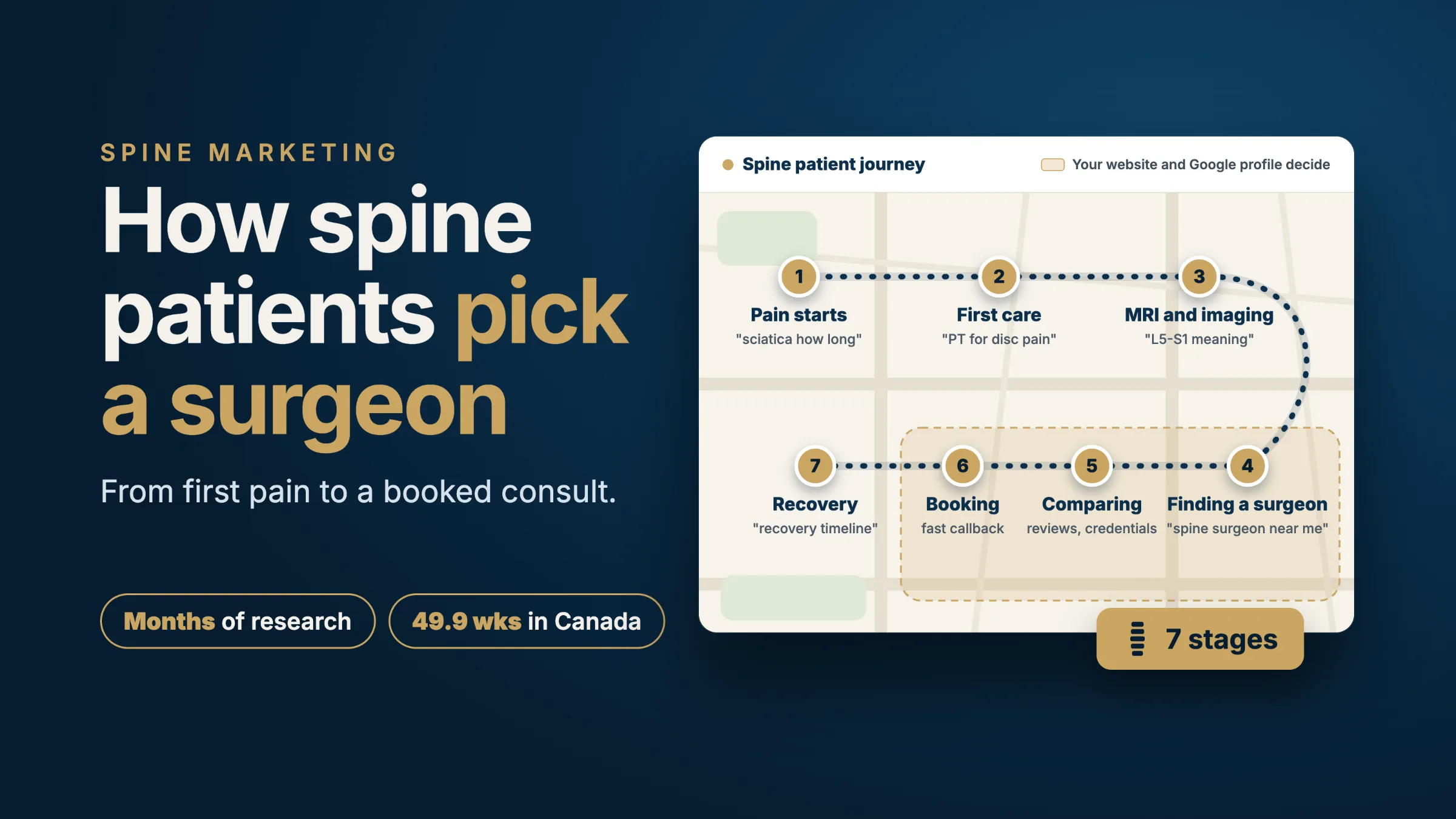
It runs in seven stages, from the first twinge of pain to the review after recovery. Each stage has its own searches and its own chance to lose the patient.
| Stage | What the patient does | What they search or ask | What your practice needs |
|---|---|---|---|
| 1. Pain starts | Rests, tries home remedies | "lower back pain shooting down leg", "numb foot after lifting" | Symptom and condition pages that explain causes and red flags |
| 2. First care | Sees a family doctor, PT or chiropractor | "physical therapy for herniated disc", "how long does sciatica last" | Strong relationships with referrers; content that respects conservative care |
| 3. Imaging | Gets an MRI, reads the report | "L5-S1 disc protrusion meaning", "spinal stenosis MRI surgery or not" | Plain-language guides to common MRI findings |
| 4. Finding a surgeon | Searches, asks AI, checks referral list | "spine surgeon near me", "best spine surgeon for stenosis in Dallas" | A Google profile per surgeon, reviews, credentials, fast-loading pages |
| 5. Comparing | Reads reviews, watches videos, gets a second opinion | "Dr. Name reviews", "minimally invasive vs open fusion" | Surgeon bios, procedure pages, honest outcomes language |
| 6. Booking | Calls, fills a form or uploads imaging | "spine surgeon accepting new patients", "MRI review online" | Same-day callback, clear referral and insurance information |
| 7. Recovery | Follows rehab, shares their experience | "recovery after microdiscectomy week by week" | Recovery guides and a consistent, rules-compliant review request |
Why is the spine journey longer than other surgeries?
Because surgery is usually the last option, not the first. Most back pain gets better on its own or with conservative care, so patients and their doctors try other treatments before anyone mentions an operation.
The National Institute of Neurological Disorders and Stroke notes that most people with back pain recover without lasting loss of function, and that surgery is generally considered when a condition doesn't respond to other therapies. In practice, a patient who ends up in your office has often spent months on physical therapy, medication or injections, and has read a lot along the way.
That long runway is an opportunity. A practice whose content helped the patient understand their MRI in month two is the practice they'll remember in month six.
Don't market spine surgery as the quick fix. Patients and referring clinicians trust spine practices that say plainly who is and isn't a surgical candidate. Honest "non-surgical options first" content builds more consults over time than aggressive surgery messaging.
What do spine patients search before they ever call?
Symptoms first, then conditions, then procedures, then surgeons. Your content should follow the same order.
- Symptom searches: leg pain, numbness, weakness, pain that wakes them up. Answer these on condition pages with clear red flags that need urgent care.
- Condition searches: herniated disc, spinal stenosis, sciatica, spondylolisthesis, degenerative disc disease. Give each condition you treat its own page or section.
- MRI language: patients copy phrases from their report into Google. A short guide to common findings (bulge versus herniation, foraminal narrowing) is some of the most useful content a spine practice can publish.
- Procedure searches: microdiscectomy, laminectomy, fusion, artificial disc replacement, minimally invasive options. Explain candidacy, recovery and risks without overpromising.
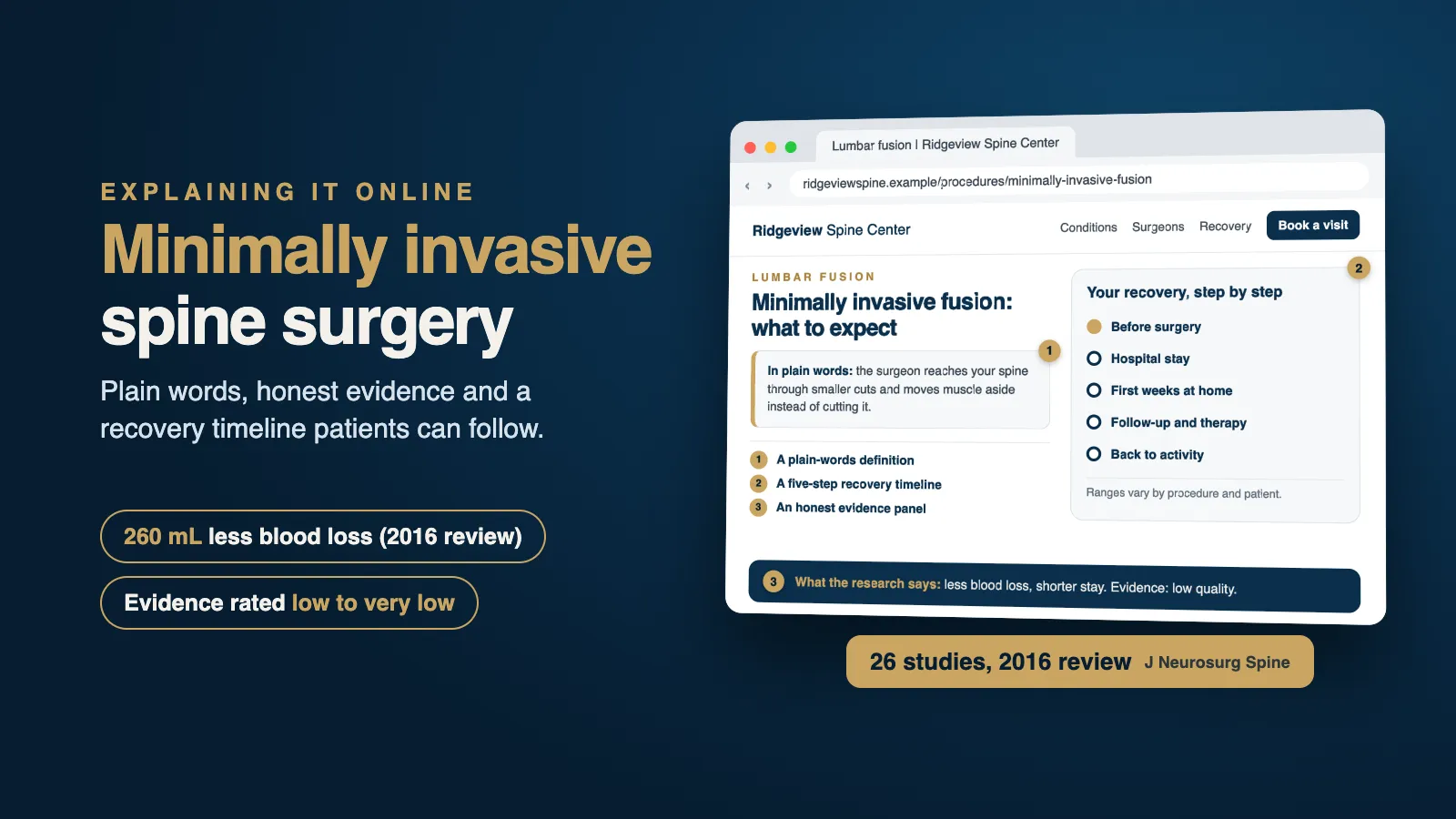
Minimally invasive surgery needs extra care because the phrase sounds like a promise. Our guide on how to explain minimally invasive spine surgery to patients shows how to define it, show the evidence fairly and set recovery expectations.
Write these pages the way you'd explain them in a consult. Our guide on writing surgery procedure pages that rank covers the structure.
How do patients compare spine surgeons online?
They look at four things: the surgeon's Google profile and reviews, credentials and fellowship training, how clearly the practice explains their condition, and, more and more, what AI assistants say when they ask who to see.
Reviews deserve special attention because the complaints that sink a spine surgeon's rating usually aren't clinical. A 2022 study in the North American Spine Society Journal analyzed one-star Yelp reviews of spine surgeons in eight major US metro areas. Of the reviews studied, 76.4% came from patients who never had surgery. The most common complaints were bedside manner (49%), rude or unprofessional staff (31%), wait times (25%) and billing or insurance problems (22%).
So the fastest way to protect your rating is the front desk and the first consult: short waits, friendly staff, clear billing and a surgeon who explains why surgery isn't right yet when that's the honest answer. Then ask happy patients for reviews consistently, within the review platform's rules.
Local visibility matters too. Google ranks local results on relevance, distance and prominence, so every spine surgeon needs their own complete Google Business Profile with the right categories and the conditions they treat.
What makes a spine patient book the consult?
Clarity and speed. By the time patients reach this stage, they're tired of pain and tired of waiting, and they'll book with the practice that makes the next step easy.
- Say who you see. List the conditions each surgeon treats and whether you take self-referrals.
- Offer an imaging review. A secure way to send an MRI report for a quick review is a strong reason to contact you over another practice.
- Explain the first visit. What to bring, how long it takes, whether imaging is needed, what happens next.
- Answer fast. A Harvard Business Review study found firms that responded to online leads within an hour were about seven times more likely to qualify them than those that waited longer. Spine patients often contact several practices at once.
How is the journey different in Canada?
The referral is the gate, and the wait is long. Most Canadian patients need a family doctor or nurse practitioner referral to see a spine surgeon in the public system.
The Fraser Institute's Waiting Your Turn 2025 report put the median wait from GP referral to treatment at 49.9 weeks for neurosurgery and 48.6 weeks for orthopaedic surgery, the two longest of any specialty, against 28.6 weeks overall. Patients spend much of that time reading about their condition and checking the surgeon they've been referred to.
For Canadian spine practices, that means two audiences: family doctors deciding where to send the referral, and patients researching while they wait. Accurate wait-time information, clear referral instructions and condition pages that help patients prepare for their consult all pay off. Our guide to growing orthopedic referrals covers the referrer side.
In both countries, keep claims modest. Avoid words like "best" or "guaranteed", don't compare yourself to other surgeons, and check provincial college or state board rules before publishing patient stories or before-and-after imaging. General information, not legal advice.
How do you turn the journey into a marketing plan?
Map one piece of content or one fix to each stage, then measure where patients drop off.
- Build condition pages for your top five spine conditions, each with symptoms, red flags, non-surgical options and when surgery makes sense.
- Publish a plain-language guide to common MRI findings.
- Complete a Google Business Profile for every spine surgeon and start a steady, compliant review routine.
- Add a referral page for physical therapists, chiropractors and family doctors.
- Set a same-day callback standard and an imaging review option.
- Track every new patient's source: referral, Google, AI assistant, ad or word of mouth.
Our spine surgeon marketing page shows how these pieces fit together for a practice.
If you want the marketing side of this path, read how to get more spine surgery patients.
Frequently asked questions
How do patients choose a spine surgeon?
Most start with a referral or a search about their symptoms, then compare surgeons on Google profiles, reviews, credentials and condition pages before booking. Many also get a second opinion. The surgeon who explains options clearly, including non-surgical ones, and answers inquiries quickly usually wins the consult.
How long does the spine patient journey take?
Often months. Most back pain improves without surgery, so patients usually try physical therapy, medication or injections first. In Canada, the Fraser Institute reported a 2025 median wait of 49.9 weeks from GP referral to treatment for neurosurgery and 48.6 weeks for orthopaedic surgery.
What content should a spine surgery website have?
One page for each condition you treat (herniated disc, spinal stenosis, sciatica, scoliosis, degenerative disc disease), honest explanations of non-surgical and surgical options, who is a candidate for minimally invasive surgery, recovery timelines, surgeon credentials, and a simple way to book a consult or a review of imaging.
Do online reviews matter for spine surgeons?
Yes. A 2022 study of Yelp reviews of spine surgeons found most one-star reviews were about bedside manner, staff, wait times and billing, and 76.4% came from patients who never had surgery. Fixing the front-desk and consult experience protects your rating more than anything clinical.
Do spine patients need a referral?
In Canada, usually yes: patients need a family doctor or nurse practitioner referral to see a spine surgeon in the public system. In the US it depends on the insurance plan; many patients can self-refer, but HMO plans often require a referral from primary care.
The bottom line
Spine patients don't choose a surgeon in one search. They choose over months, through symptom searches, conservative care, MRI reports, referrals, reviews and second opinions. Be useful at every stage: explain conditions honestly, help patients read their imaging, make every surgeon easy to find and easy to reach, and fix the front-desk issues that drive bad reviews. Want to see where your practice loses spine patients today? Request a free practice growth audit.
General information, not legal or medical advice. Rules change, so confirm anything compliance-related with your own advisor and your state board or provincial College.