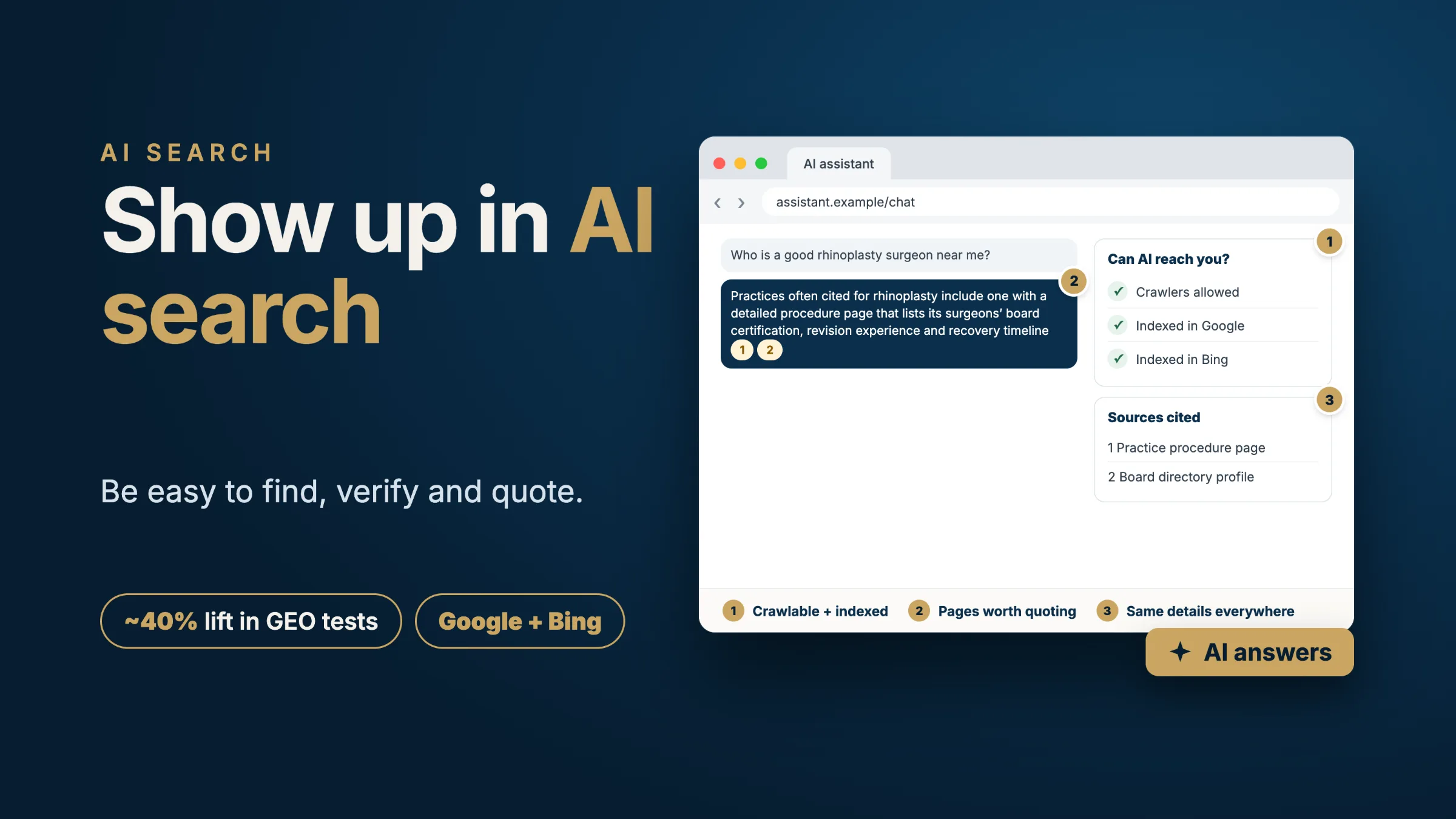
Surgeons show up in ChatGPT and AI search the same way they earn trust in Google: by being easy to find, easy to verify and worth citing. AI engines build answers from pages they can crawl and sources they trust, so the work is clean indexing in Google and Bing, consistent practice details everywhere, procedure pages full of specific, sourced facts, strong reviews and mentions on third-party sites. No one can guarantee a mention.
Why it matters: patients now ask AI tools questions like "who's the best hip replacement surgeon in Calgary" or "what's recovery like after a tummy tuck." The answer names a few practices and cites a few pages. This is generative engine optimization (GEO): making your practice one of the sources those answers draw on. It's mostly good SEO for surgeons done properly, with a few extra steps most practices haven't taken.
Want to know if AI tools mention your practice today? Our AI search visibility for surgeons service tests your key procedures across ChatGPT, Google, Perplexity and Gemini every month and fixes what's holding you back.
How do AI search engines pick which sources to cite?
Each engine runs a search behind the scenes, pulls a set of pages, then writes an answer from them. If your pages aren't in the index they search, or don't clearly answer the question, you can't be cited.
| Engine | Where it finds sources | What to do |
|---|---|---|
| Google AI Overviews and AI Mode | Google's own index. Pages must be indexed and eligible to show with a snippet. | Normal Google SEO. Check indexing in Search Console. |
| ChatGPT search | A set of search services, with Bing an important one, plus OpenAI's OAI-SearchBot crawler | Verify in Bing Webmaster Tools; allow OAI-SearchBot. |
| Perplexity | Its own index built by PerplexityBot, plus live fetches | Allow PerplexityBot in robots.txt. |
| Gemini | Grounding in Google Search | Same fundamentals as Google. |
| Microsoft Copilot | Bing's index and grounding | Bing Webmaster Tools and IndexNow. |
Google is explicit. Its guidance on AI features says there are no additional requirements or special optimizations for AI Overviews or AI Mode beyond being indexed and snippet-eligible. It also says these features may run several related searches across subtopics, a technique it calls query fan-out, which is why a well-organized site with a page for each procedure and question has more chances to be pulled in.
For ChatGPT, OpenAI's crawler documentation says OAI-SearchBot is what surfaces sites in ChatGPT search, and sites that block it won't be shown in ChatGPT search answers. OpenAI has also said publicly that it uses a set of search services and that Bing is an important one. Perplexity's crawler documentation says PerplexityBot is how sites get surfaced and linked in its results.
What can a surgeon actually influence?
You can influence whether engines can reach you, whether your facts are consistent, whether your pages are worth quoting and whether other trusted sites talk about you. You can't influence the exact wording of any answer.
Two pieces of evidence point the same way. The Princeton-led GEO study by Aggarwal and colleagues found that adding statistics, quotations and cited sources to content raised its visibility in generative engine answers by up to about 40% in their tests. And Whitespark's 2026 Local Search Ranking Factors survey added an AI visibility score for the first time, noting that three of the top five factors for AI search visibility were citation factors, meaning consistent listings across the web.
Step 1: Can AI crawlers reach your site?
Check your robots.txt and firewall before anything else. Some security plugins and CDN settings block AI crawlers by default, and nobody at the practice ever knows.
Allow Googlebot, Bingbot, OAI-SearchBot and PerplexityBot. If you don't want your content used to train models, you can block GPTBot separately; OpenAI says these settings are independent. Make sure key content is in plain HTML text, not hidden in images, PDFs or tabs that only load on click.
Step 2: Are you indexed in both Google and Bing?
Verify your site in Google Search Console and Bing Webmaster Tools, submit your sitemap to both, and fix anything excluded. Bing matters far more than its search share suggests because ChatGPT and Copilot rely on it.
Two newer tools help. Bing Webmaster Tools added an AI Performance report in public preview in February 2026, showing how often your pages are cited in Copilot and Bing AI answers and the "grounding queries" behind them, according to Koozai's coverage. Google added Search Generative AI performance reports to Search Console in June 2026 and rolled them out to all sites by August 31, 2026, per Search Engine Journal. Both show impressions or citations, not clicks or patients, so treat them as visibility signals.
IndexNow is worth setting up too. It's a protocol launched by Microsoft Bing and Yandex in 2021 that pings participating search engines the moment you publish or update a page. Google doesn't use it, but Bing does, and fresher Bing data means fresher sources for Bing-powered AI answers. Most WordPress SEO plugins and many CDNs support it with a toggle.
Step 3: Is your practice described the same way everywhere?
AI engines cross-check facts. If your website, Business Profile, hospital page, society directory and Healthgrades listing disagree about your name, address, specialties or credentials, you look less certain, and engines tend to cite sources they're confident about.
Make the core facts identical: practice name, surgeon names and credentials, board certification, specialties, address, phone, hospital affiliations and years in practice. Then add structured data on your site so machines can read the same facts directly: Organization or a medical business type for the practice, Person or Physician for each surgeon, and sameAs links to your official profiles. Google says structured data should match what's visible on the page, so don't mark up anything a patient can't read. A properly set up Google Business Profile is the backbone of this consistency.
Step 4: Are your pages worth quoting?
AI engines quote passages that answer a question directly, with specific facts and a credible source. Vague marketing copy rarely gets cited.
Open each page and section with a direct, two to three sentence answer. Include specifics that only a real practice can give: which hospitals you operate at, how long a typical consult takes, what the recovery timeline looks like in your protocol, and what's included in your quoted fee. Cite authoritative sources for medical claims, such as the FDA, specialty societies and peer-reviewed studies. Add a visible author and medical reviewer with credentials and a review date. Google's helpful content guidance says health content must be highly accurate and consistent with expert consensus, and that standard is what AI engines are drawing on too. We cover the full page structure in how to write surgery procedure pages that rank.
Step 5: Do other trusted sites talk about you?
AI answers about "the best surgeon for X in Y" lean heavily on third-party sources: reviews, directories, hospital pages, society listings, local news and "best of" lists. Your own website alone rarely carries the answer.
Focus on sources that are real and earned. Keep a steady flow of Google reviews and reviews on the directories patients use in your specialty. Make sure every hospital and surgery center where you hold privileges lists you correctly. Claim your specialty society's find-a-surgeon listing. Say yes to local media requests where you can genuinely help. Avoid paid "top doctor" awards that exist mainly to sell plaques; they don't add much trust and some regulators frown on them.
What about llms.txt?
llms.txt is an emerging convention: a plain-text file at your site's root that summarizes your most important pages for AI tools. It's not a ranking factor, and no major engine has said it relies on it.
Google's John Mueller compared it to the old keywords meta tag in 2025, as reported by Search Engine Journal, and Google's AI features guidance says you don't need new AI text files to appear. Our view: it takes an hour, it doesn't hurt, and it may help some tools that fetch your site directly. Add one if you like, keep it accurate, and spend the rest of your time on the steps above.
How do you test AI visibility every month?
Pick a fixed set of 15 to 30 prompts that patients would actually ask, run them in each engine on the same day each month, and log whether your practice is named or cited. Answers vary, so look at trends, not single results.
- Build the prompt list. Mix "best [procedure] surgeon in [city]," "[procedure] cost in [city]," "[procedure] recovery time" and a few questions about your surgeons by name.
- Run them consistently. Use ChatGPT with search, Google AI Mode and AI Overviews, Perplexity and Gemini. Use a fresh, signed-out session or a clean profile where you can, and note the location.
- Log three things. Was the practice named? Was your website cited? Which other sources were cited?
- Check the platform reports. Bing's AI Performance report and Search Console's generative AI reports show which pages are being cited and for what.
- Act on the gaps. If a directory or competitor page keeps getting cited instead of you, that's your to-do list: get listed there, or build the page that answers the question better.
Also check for errors. If an AI tool states the wrong address, outdated fees or a procedure you don't offer, trace where the wrong fact lives (often an old directory listing) and fix it at the source.
Are there US and Canada differences?
The engines work the same in both countries, but the content rules on your own pages differ. AI tools can quote anything you publish, so publish only what your regulator allows.
In Ontario, the CPSO's advertising policy bans testimonials and sets strict rules for before and after images. Quebec requires French-language commercial content. In the US, state medical boards set advertising rules, and the FTC prohibits unsupported claims. If a claim wouldn't pass your board or College, it shouldn't be on a page an AI engine might quote.
Want a baseline before you start? Request a free surgeon marketing audit and we'll include a quick check of how your practice appears in AI answers for your main procedures, delivered as a short video.
Frequently asked questions
Can anyone guarantee my practice will be recommended by ChatGPT?
No. AI answers change by question, location, wording and over time, and no one controls them. Anyone promising guaranteed AI placement is overselling. What you can do is make your practice easy to find, verify and cite.
Do I need an llms.txt file?
It's optional. llms.txt is an emerging convention, not a ranking factor, and Google says you don't need new AI text files to appear in its AI features. It's cheap to add, but don't expect it to change results on its own.
Does ChatGPT use Google or Bing?
OpenAI has said ChatGPT search uses a set of search services and that Bing is an important one. That's why Bing indexing and Bing Webmaster Tools matter more now than they used to.
Should I block AI crawlers from my website?
If you want to be cited in AI search, don't block the search crawlers such as OAI-SearchBot, PerplexityBot and Bingbot. You can block model training crawlers like GPTBot separately without affecting ChatGPT search visibility.
How long does it take to show up in AI answers?
There's no fixed timeline. Fixing crawl access and indexing can help within weeks, while building reviews, mentions and authoritative content takes months. Track it monthly with a fixed set of test prompts.
The bottom line
There's no secret switch for AI search. Make sure every engine can crawl and index you, describe your practice identically everywhere, write procedure pages with specific, sourced facts and named reviewers, and earn real mentions on sites patients trust. Then test the same prompts every month and fix what you find. That's the honest version of generative engine optimization, and it's the version that lasts.
General information, not legal or medical advice. Rules change, so confirm anything compliance-related with your own advisor and your state board or provincial College.