HIPAA compliant marketing for surgeons means promoting your practice without exposing protected health information (PHI) to people or tools that have no right to it. In practice that comes down to five things: tracking on your website, business associate agreements with vendors, consent for texts and emails, written authorization for testimonials and photos, and, in Canada, express consent under PIPEDA, provincial health privacy acts, CASL and Quebec Law 25.
Why it matters: surgical marketing runs on the exact data privacy laws care about most. A form that asks "which procedure are you considering?" is health information. A pixel that sends that answer to an ad platform is a disclosure. Most violations we see aren't malicious. They're a plugin someone installed in 2021 and forgot about.
Not sure what your website is sending to ad platforms? Our free surgeon marketing audit includes a tracking and forms check, delivered as a short video in 2 business days.
A quick note before we start: we're a marketing agency, not lawyers. This guide explains how the rules affect day-to-day marketing decisions. It isn't legal advice, and you should confirm anything that affects your practice with a healthcare privacy attorney (US) or privacy counsel (Canada).
What does HIPAA actually say about marketing?
HIPAA says a covered practice generally needs a patient's written authorization before using or disclosing their PHI for marketing. The rule is narrower than most people think, and it has real exceptions.
According to HHS guidance on the Privacy Rule's marketing provisions, "marketing" is a communication about a product or service that encourages the recipient to buy or use it. Several things are carved out of that definition, including communications about your own health-related services, treatment communications and recommendations of alternative treatments. Face-to-face conversations and promotional gifts of nominal value also don't need authorization.
What that means for a surgical practice:
- Usually fine without authorization: telling your own existing patients about a new procedure you offer, sending post-op care instructions, or a surgeon discussing options in the exam room.
- Needs authorization: using a patient's name, face, story or results in an ad, on social media or on your website; sharing patient lists with a third party; anything where a third party pays you to promote its product.
- Never without authorization: selling PHI or patient lists. HHS says this rule has no exceptions.
Public ad campaigns that target strangers (Google search ads, SEO, billboards) don't use PHI at all, so HIPAA's marketing rule doesn't touch them. The risk lives in the data your website and tools collect once someone responds.
Can surgeons use tracking pixels and analytics after the 2024 court ruling?
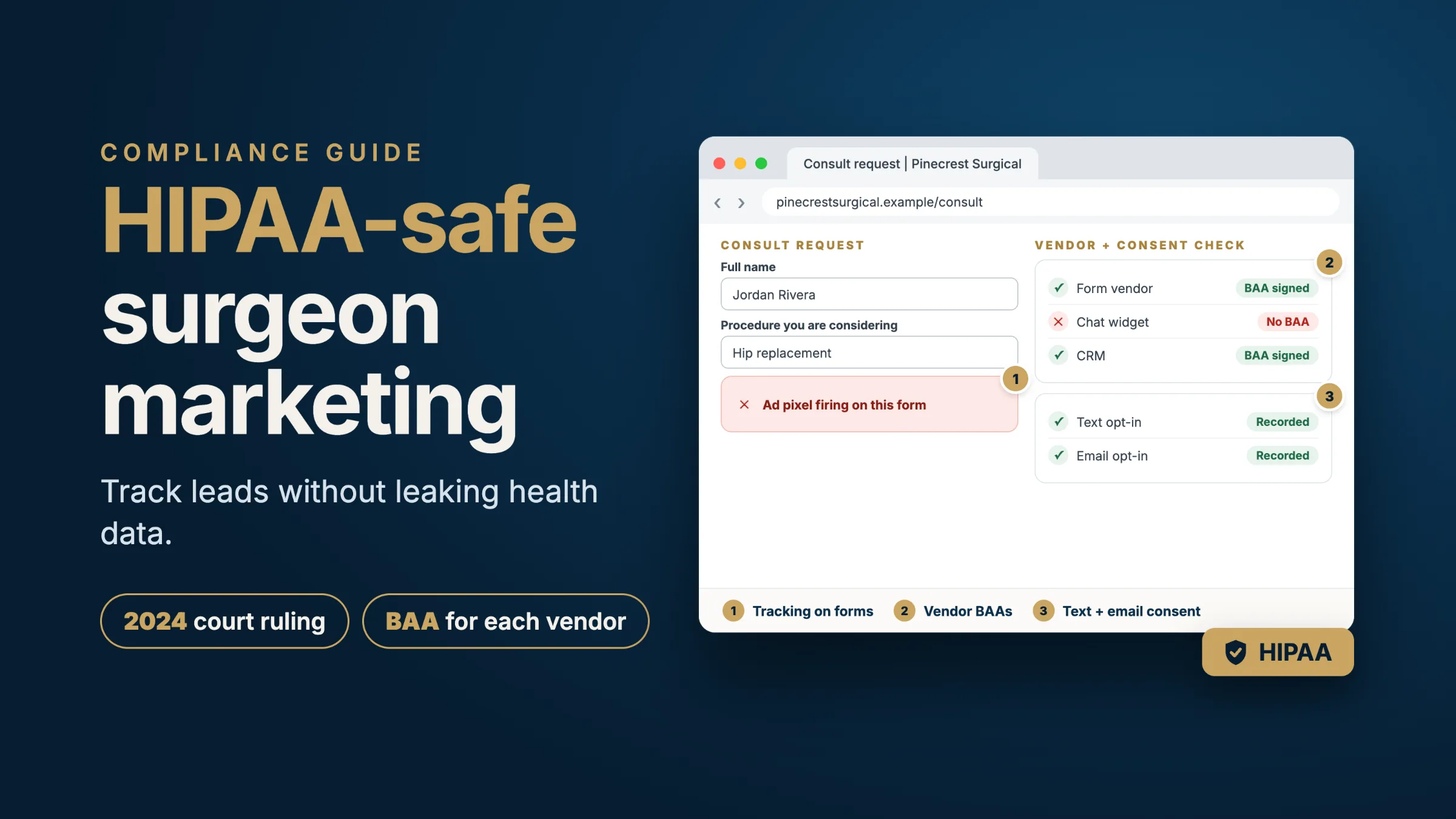
Yes, with limits. A federal court narrowed HHS's tracking guidance in 2024, but tracking on logged-in pages, patient portals and forms that collect health details is still a HIPAA problem without a BAA.
Here's the timeline. HHS's Office for Civil Rights (OCR) issued guidance on online tracking technologies in December 2022 and updated it in March 2024. It said that an IP address combined with a visit to a public page about a specific condition or provider could be PHI. On June 20, 2024, in American Hospital Association v. Becerra, a federal court in the Northern District of Texas vacated that specific part, which it called the "proscribed combination." HHS then decided not to appeal the ruling in August 2024.
What the ruling did not change, per Morrison Foerster's analysis:
- Tracking on authenticated pages (patient portals, logged-in booking) still involves PHI and needs a BAA with the vendor.
- Pages where the visitor tells you their health situation, like an intake form or a "which procedure?" quiz, are still covered.
- The Security Rule and the need for BAAs with vendors that receive PHI still apply.
Our take: the ruling lowered the risk on blog posts and procedure pages. It didn't make Meta Pixel on your consultation form safe. The practical setup we recommend is analytics on public pages, no third-party pixels on forms or booking flows, and conversions passed back to ad platforms as anonymous events (a "lead" happened) rather than form contents. Server-side tagging through a vendor that signs a BAA is the cleaner version of this.
State law can be stricter than HIPAA. Washington's My Health My Data Act covers consumer health data that HIPAA doesn't, applied to most businesses from March 31, 2024, and a violation counts under the state Consumer Protection Act. If you advertise to Washington residents, treat it as its own checklist item.
Which marketing vendors need a business associate agreement?
Any vendor that creates, receives, stores or transmits PHI on your behalf needs a BAA before it touches that data. If a vendor won't sign one, it shouldn't get PHI.
| Vendor or tool | Touches PHI? | What to do |
|---|---|---|
| Website host and form tool | Usually yes (form submissions) | Use a host and form tool that signs a BAA, or keep health details off web forms |
| CRM or lead inbox | Yes | BAA required |
| Call tracking and call recording | Yes (callers describe symptoms) | BAA required; check recording consent laws by state |
| Texting and email platform | Yes, if messages reference care | BAA required for patient messages |
| Marketing agency | Depends on access | BAA if they see leads, recordings or patient lists |
| Google Ads, Meta Ads | Should be no | Send only anonymous conversion events, never form contents |
| Review platform | Yes, if you upload patient lists | BAA, or send review requests from your own BAA-covered system |
One thing people miss: a BAA is necessary but not sufficient. You still need to configure the tool so it only gets the minimum data it needs.
How do HIPAA rules apply to testimonials, photos and review replies?
Using any identifiable patient information in marketing, including photos, names, stories or results, needs a signed HIPAA authorization. Replying to online reviews with patient details is a disclosure too, and OCR has fined practices for it.
Two real enforcement examples worth knowing:
- In September 2025, OCR settled with Cadia Healthcare Facilities for $182,000 after it posted 150 patients' information through a "success story" program without valid written authorizations.
- In 2022, a California dental practice paid $23,000 after responding to online reviews in a way that disclosed patients' PHI.
For surgical practices, the checklist is short:
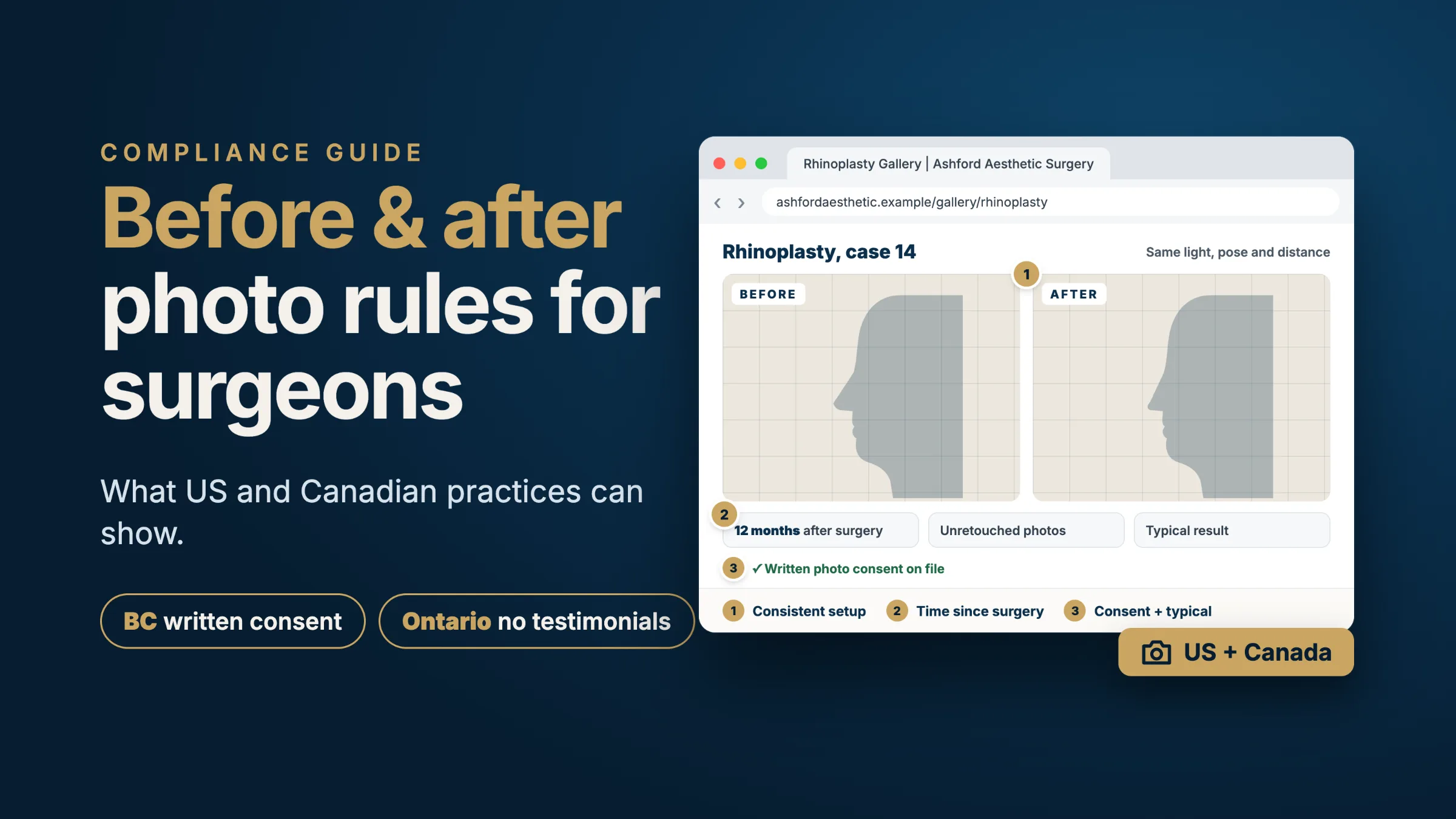
- Get a HIPAA-compliant authorization form for every before-and-after photo, video testimonial or case story. Generic consent-to-treat forms don't count.
- Make the authorization specific: which images, which channels, how long, and how to revoke.
- Never confirm someone is a patient when replying to a review. "We take every concern seriously, please call our office" is the safe template. Our guide to getting more patient reviews covers compliant review requests.
- Remember the FTC too. Its 2024 rule on fake reviews and testimonials bans fake and bought reviews, and results shown in ads should be typical, not cherry-picked.
What consent do you need to text and email patients?
In the US, marketing texts sent with automated tools generally need prior express written consent under the TCPA, and marketing emails must follow CAN-SPAM. Appointment reminders and care messages get more room, but they still need consent and a way to opt out.
The TCPA distinctions that matter for surgeons, summarized from Manatt's TCPA healthcare review:
- Healthcare messages (appointment reminders, pre-op instructions) sent by or for a HIPAA covered entity generally need prior express consent, such as the patient giving you their mobile number for that purpose.
- Marketing texts ("20% off fillers this month") need prior express written consent that names your practice, the number, and the fact that automated marketing messages will be sent.
- Since April 11, 2025, the FCC requires you to honor opt-outs made by any reasonable means (replying "stop," "cancel," or even "please stop texting me") within 10 business days.
For email, the FTC's CAN-SPAM guide requires accurate sender details, honest subject lines, your physical address and an opt-out you honor within 10 business days. CAN-SPAM doesn't require opt-in consent, but if the email relies on PHI (for example, segmenting by procedure history to promote a different service), HIPAA's marketing rules apply on top.
How is Canada different: PIPEDA, PHIPA and provincial laws?
Canada has no HIPAA. Depending on the province, a surgical practice follows PIPEDA, a provincial health privacy act, or a provincial private sector act, and all of them lean toward express consent for health information.
The Office of the Privacy Commissioner of Canada lists the health privacy laws deemed substantially similar to PIPEDA: Ontario's PHIPA, plus health information acts in New Brunswick, Newfoundland and Labrador, and Nova Scotia. Alberta, British Columbia and Quebec have their own private sector laws, and Alberta also has its Health Information Act.
The marketing-relevant points:
- Ontario (PHIPA): the Information and Privacy Commissioner of Ontario says custodians need express consent to collect, use or disclose personal health information for marketing or market research.
- Retargeting on health interests: in a 2014 finding about ads that followed a man who'd searched for CPAP devices, the OPC concluded that online behavioural advertising based on health information requires express consent.
- Advertising rules from Colleges: the CPSO advertising policy bans patient testimonials in physician advertising in Ontario and holds physicians responsible for ads their agencies create. Check your own provincial College before running any testimonial.
What do CASL and Quebec Law 25 mean for your marketing?
CASL governs every commercial email and text you send in Canada, and Law 25 adds Quebec's strictest-in-Canada rules on consent, cookies and tracking. Both carry real penalties.
Under CASL, you need consent before sending a commercial message. Express consent lasts until withdrawn. Implied consent from an existing relationship lasts up to 2 years, and only 6 months after an inquiry. A consultation request that never turned into a booking gives you 6 months, not forever. Every message needs your business name, contact details and an unsubscribe you honor within 10 business days.
Quebec's Law 25 phased in between 2022 and 2024. Its September 2023 wave requires you to tell people when you use technology that can identify, locate or profile them (ad cookies included) and how to turn it on. Penal fines for businesses reach $25 million or 4% of worldwide turnover, per Clyde & Co's summary. If you market to Quebec residents, the safe reading is a real consent banner with ad and profiling cookies off until people opt in.
A compliance checklist surgical practices can use this week
Most practices can close the biggest gaps in a week. Start with tracking and forms, because that's where silent violations happen.
| Area | United States | Canada |
|---|---|---|
| Website tracking | No third-party pixels on forms, portals or booking; BAA for any tool that sees PHI | Consent banner; health-based retargeting needs express consent; Quebec: profiling cookies off until opt-in |
| Vendors | BAA with CRM, forms, call tracking, texting, agency | Written agreements with service providers; confirm data residency and safeguards |
| Marketing texts | TCPA prior express written consent | CASL consent, ID and unsubscribe |
| Marketing emails | CAN-SPAM; HIPAA authorization if PHI drives targeting | CASL consent; implied consent expires |
| Testimonials and photos | Signed HIPAA authorization; FTC truthfulness rules | Express consent; check your College (CPSO bans testimonials) |
| Review replies | Never confirm a patient relationship | Same rule; College and privacy law both apply |
Then document it. A one-page marketing privacy policy for your staff, listing what tools you use and what data each gets, is worth more than a 40-page binder nobody opens.
Want lead generation that's built with privacy in mind? See how our lead generation for surgeons handles forms, call tracking and follow-up, or read how we work with surgical practices.
Frequently asked questions
Is Google Analytics HIPAA compliant for a surgical practice?
Google does not sign a business associate agreement for Google Analytics, so it should not receive protected health information. Using it on public, logged-out marketing pages is lower risk after the 2024 court ruling, but keep it off patient portals, intake forms and booking flows that capture health details.
Do I need patient permission to post a testimonial or before-and-after photo?
Yes. In the US, a covered practice needs a signed HIPAA authorization before using a patient's identifiable information or photos in marketing. In Canada you need express consent, and some provincial Colleges, such as the CPSO in Ontario, ban patient testimonials in physician advertising outright.
Can I text patients about a new procedure we offer?
In the US, a promotional text sent with automated tools generally needs prior express written consent under the TCPA. Appointment reminders follow looser rules. In Canada, promotional texts are commercial electronic messages under CASL and need consent, sender identification and a working unsubscribe.
Does my marketing agency need to sign a BAA?
If the agency will create, receive, store or transmit protected health information for you, such as form submissions, call recordings or patient lists, then yes. If it only works with anonymous, aggregated data and never touches PHI, a BAA may not be required, but get that scope in writing.
Does HIPAA apply to Canadian surgical practices?
No. HIPAA is US law. Canadian practices follow PIPEDA or a provincial law such as Ontario's PHIPA, Alberta's Health Information Act or Quebec's private sector act as amended by Law 25, plus CASL for commercial email and texts.
The bottom line
You can market hard and stay compliant. Keep patient data out of tools that shouldn't have it, get real consent before you use someone's story, and follow the messaging rules on each side of the border. Fix your tracking and forms first, sign BAAs with every vendor that touches PHI, and run anything involving testimonials past your College's rules and your lawyer.
General information, not legal or medical advice. Rules change, so confirm anything compliance-related with your own advisor and your state board or provincial College.