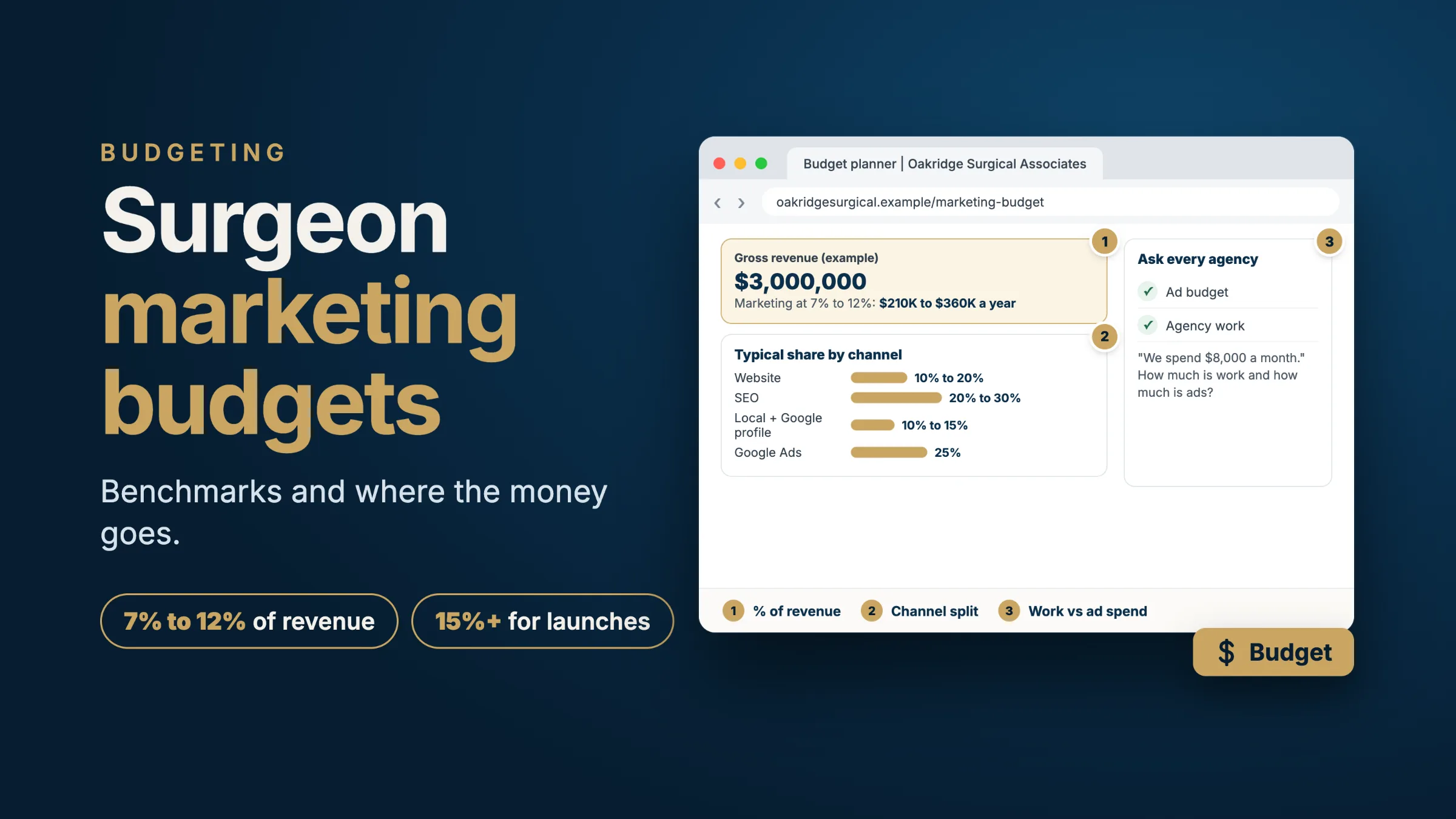
Most surgical practices spend about 7% to 12% of their gross revenue on marketing. Established practices with steady referrals often sit near the lower end. Practices that are new, opening a second location, or promoting a high-value elective procedure usually spend more, sometimes 15% or higher for a season.
The right number for you depends on a few things: your specialty, how competitive your city is, whether you rely on referrals or direct patients, and how fast you want to grow. This guide gives you the benchmarks, shows where the money goes, and offers a simple way to set a budget you can defend.
Not sure what your practice should spend? Get a free, no-pressure look at your numbers. Contact us and we will map a starting budget for your specialty and city.
How much do surgeons typically spend on marketing?
A widely cited benchmark is that businesses earning under $5 million a year spend 7% to 8% of gross revenue on marketing. Surgical practices often use a similar range, then adjust for how much they depend on new patients versus referrals.
Here is a simple way to think about it by situation.
| Practice situation | Typical marketing spend (% of gross revenue) |
|---|---|
| Established, referral-heavy | 5% to 7% |
| Established, growing elective cases | 8% to 10% |
| New practice or new location | 12% to 15% or more |
| Competitive elective market (plastics, LASIK, hair) | 10% to 15% or more |
These are starting points, not rules. A solo plastic surgeon in a crowded metro will spend differently than a spine group that gets most of its cases from physician referrals. The goal is a number that brings in enough qualified patients to grow, without stretching the practice.
What goes into a surgical practice's marketing budget?
Your total budget has two parts, and mixing them up is the most common budgeting mistake.
- Agency or staff fees: the people, strategy and tools that plan and run your marketing.
- Advertising spend: the money that goes straight to Google or Meta to show your ads.
Keep these two separate on paper. When you hear "we spend $8,000 a month," you want to know how much is work and how much is ad budget, because they do very different jobs. One builds the system. The other buys reach today. If you cut the agency work to put more into ads, the ads often perform worse, because no one is watching the numbers or fixing what is not converting.
If you want a plain breakdown of fees versus ad spend for a practice like yours, you can see how our pricing works.
Where does a surgeon's marketing budget actually go?
Most practices split their budget across a few core channels. Each one has a job in turning a search into a booked consult.
| Channel | What it does | Typical share of the budget |
|---|---|---|
| Website and conversion | Turns visitors into consult requests | 10% to 20%, mostly upfront |
| SEO | Ranks you for the procedures patients search | 20% to 30% |
| Local search and Google Business Profile | Wins the map pack and "near me" searches | 10% to 15% |
| Google Ads | Brings fast, high-intent inquiries | 25% to 40% |
| Reviews and reputation | Builds trust before the first call | 5% to 10% |
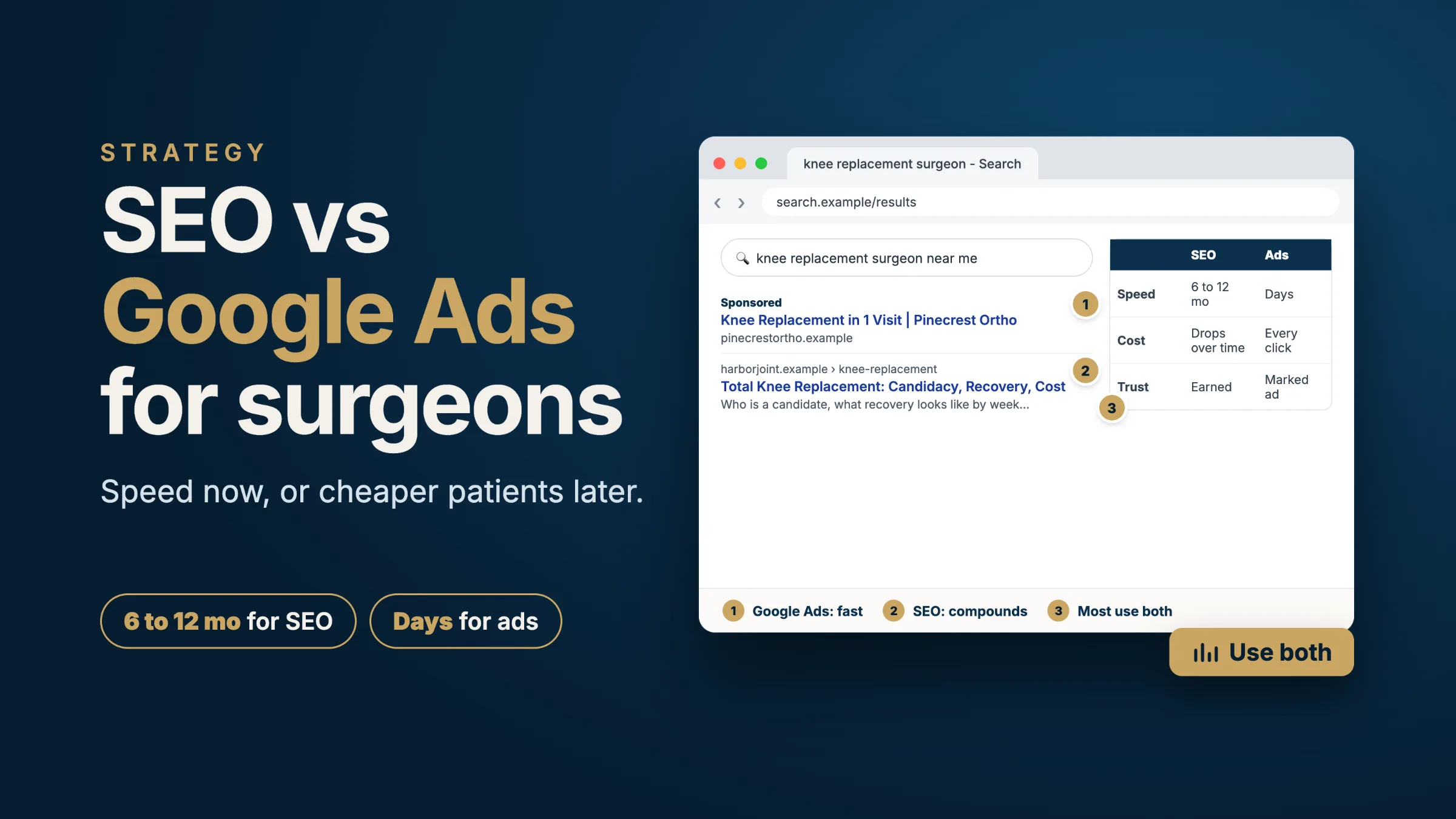
The mix matters more than the total. Strong search engine optimization for surgeons keeps bringing patients month after month, while Google Ads for surgeons can fill the schedule within weeks. A complete Google Business Profile and local search setup helps you show up when someone nearby searches for your procedure.
A new practice usually puts more into the website and paid ads early, because it needs patients now. An established practice shifts more toward SEO and reviews, which compound over time and lower the cost of each new patient.
Does marketing spend change by surgical specialty?
Yes, and the gap is wide. The biggest factor is how much a specialty depends on patients who choose and pay on their own versus patients who arrive through insurance and physician referrals.
Fully elective fields spend the most. Plastic surgery, cosmetic dermatology, LASIK and hair restoration sit at the top of the range, often 10% to 15% of revenue. Patients pay out of pocket, they compare several surgeons, and the market is crowded, so these practices lean on paid ads, strong before-and-after visuals, and reviews.
Referral and insurance driven fields spend less. Orthopedic, spine, ENT and general surgery often sit near 5% to 8%, with more weight on search rankings, reputation and referral relationships than on paid ads.
High-consideration fields land in the middle. Bariatric surgery and fertility care involve a long, research-heavy decision, so budgets around 8% to 12% go toward helpful content and reviews that build trust over weeks, not days.
How is the budget different for new and established practices?
A new practice should front-load the website and Google Ads. You need inquiries quickly, so expect a higher percentage of revenue, often 12% to 15%, for the first 6 to 12 months while your organic visibility builds.
An established practice can run leaner. With rankings and reviews already in place, a steady 6% to 9% often holds the schedule, with extra budget added only when you push a specific procedure or open a new location.
Want a budget built around your procedures, not a template? Talk to our team and we will show you what a realistic plan looks like for your market.
How do you set the right marketing budget for your practice?
You do not need a complex formula. Five steps get you a number you can trust.
- Know what a patient is worth. Estimate the average revenue from one new surgical patient, including follow-up care.
- Set a goal. Decide how many extra consults or surgeries you want each month.
- Work backward. If a booked consult costs roughly $150 to $300 to generate, you can estimate the ad budget needed to hit your goal.
- Pick a starting percentage. Use the benchmarks above, then commit to it for 90 days before judging.
- Measure and move the money. Put more into what books patients and cut what does not.
Step three is where most practices lose money, because inquiries arrive but never turn into booked surgeries. Fast follow-up and a clear booking path, the heart of lead generation and conversion, often matter more than spending more on ads.
How do you know if your marketing budget is working?
Judge your budget by patients, not clicks. Three numbers tell you almost everything.
- Cost per lead: what you pay for one new inquiry.
- Cost per booked consult: what you pay for one patient who actually books.
- Booked surgeries and revenue: the number that pays for the whole program.
A budget is working when the cost per booked consult is comfortably below what a patient is worth to your practice. If you spend $250 to book a consult and an average surgical patient is worth thousands, the math works. You can see how this plays out across specialties in our surgical and clinic case studies.
Here is a simple example. Say you spend $6,000 in a month and generate 40 inquiries. That is $150 per inquiry. If 10 of those inquiries book a consult, your cost per booked consult is $600. If 4 of those consults become surgeries worth $8,000 each, you brought in $32,000 of booked revenue from $6,000 of spend. Numbers like these, tracked every month, tell you whether to hold, raise or reshape the budget. Guessing does not.
Common budgeting mistakes surgeons make
A few habits quietly waste money. Watch for these.
- Judging marketing by traffic and clicks instead of booked consults.
- Cutting the budget the month after it starts working.
- Spending on ads before the website converts visitors into inquiries.
- Treating ad spend and agency fees as one lump sum.
- Choosing the cheapest agency instead of the one that tracks real patients.
If you are deciding where your first dollars should go, our guide on SEO vs Google Ads for surgeons compares the two and shows when each one wins.
Frequently asked questions
What percentage of revenue should a surgical practice spend on marketing?
Most spend 7% to 12% of gross revenue. New or highly competitive practices often spend more, while established, referral-heavy practices spend less.
How much do surgeons spend on Google Ads each month?
It varies by market, but many practices start with $2,000 to $5,000 per month in ad spend, plus a management fee. Competitive elective markets often need more.
Is SEO or paid advertising cheaper for surgeons?
SEO usually costs more to build at first, then lowers your cost per patient over time. Paid ads bring patients faster but stop the moment you turn them off. Most practices use both.
How long before marketing pays off?
Paid ads can bring inquiries within a few weeks. SEO and local search usually take 6 to 12 months to show strong, lasting results.
Should a new surgical practice spend more than an established one?
Yes. A new practice has no rankings or reviews yet, so it needs a higher share of revenue, often 12% to 15%, until organic visibility catches up.
The bottom line
There is no single right number, but there is a right range. Start near 7% to 12% of revenue, keep your agency fees and ad spend separate, and judge the budget by booked consults rather than clicks. Review it every quarter and move money toward what works.
Ready to turn a marketing budget into booked consultations? Get in touch with our team for a free practice growth audit, and we will show you exactly where your next patients will come from.
General information, not legal or medical advice. Rules change, so confirm anything compliance-related with your own advisor and your state board or provincial College.