To grow orthopedic referrals, make your practice the easiest and safest place for primary care doctors, physical therapists and chiropractors to send patients. Offer fast appointments for referred patients, publish clear referral criteria, send consult notes back within two days, make referring possible online, and track every referrer. Never pay, trade or reward anyone for referrals.
Search and ads bring in self-referred patients, and they matter. But a big share of orthopedic volume still starts with another clinician saying "you should see an orthopedic surgeon about that." This guide covers who those clinicians are, what they actually want from you, and how to earn more of their trust. It also covers the legal lines, because referral marketing is one of the few areas where a well-meant thank-you gift can turn into a federal problem.
Who actually sends patients to an orthopedic practice?
Primary care is usually the largest source, with physical therapists, urgent care and emergency physicians, chiropractors and sports medicine doctors behind it. The exact mix depends on your subspecialties, so start with your own data, not a guess.
Pull the referring-provider field from your practice management system for the last 12 months. Sort by referrer and by subspecialty. Most practices find that a small group of clinicians sends a large share of patients, and that a few once-busy referrers have gone quiet. Both lists are useful.
| Referral source | Patients they usually send | What they need from you |
|---|---|---|
| Primary care (MDs, DOs, NPs, PAs) | Knee and hip arthritis, shoulder pain, back pain, fractures | Fast access, clear criteria, short consult notes, a direct line for questions |
| Physical therapists | Patients not improving after a course of therapy, suspected tears | Respect for their plan, a way to send imaging questions, patients sent back for rehab when appropriate |
| Chiropractors | Back and neck pain with red flags or no progress | Clear red-flag guidance, quick triage, a professional tone |
| Urgent care and ER | Fractures, dislocations, acute sports injuries | Next-day fracture slots and one number that always answers |
| Sports medicine and athletic trainers | ACL, meniscus, shoulder instability, overuse injuries | Fast imaging and surgical opinions, return-to-play communication |
Athletic trainers and sports medicine referrals have their own rhythm, built on same-week injury slots and fast return-to-play updates. We cover that side in our sports medicine marketing ideas post.
Why do referrals matter even more in Canada?
Because most Canadian patients need a referral to see an orthopedic surgeon at all, and the wait is long. The referral is the front door.
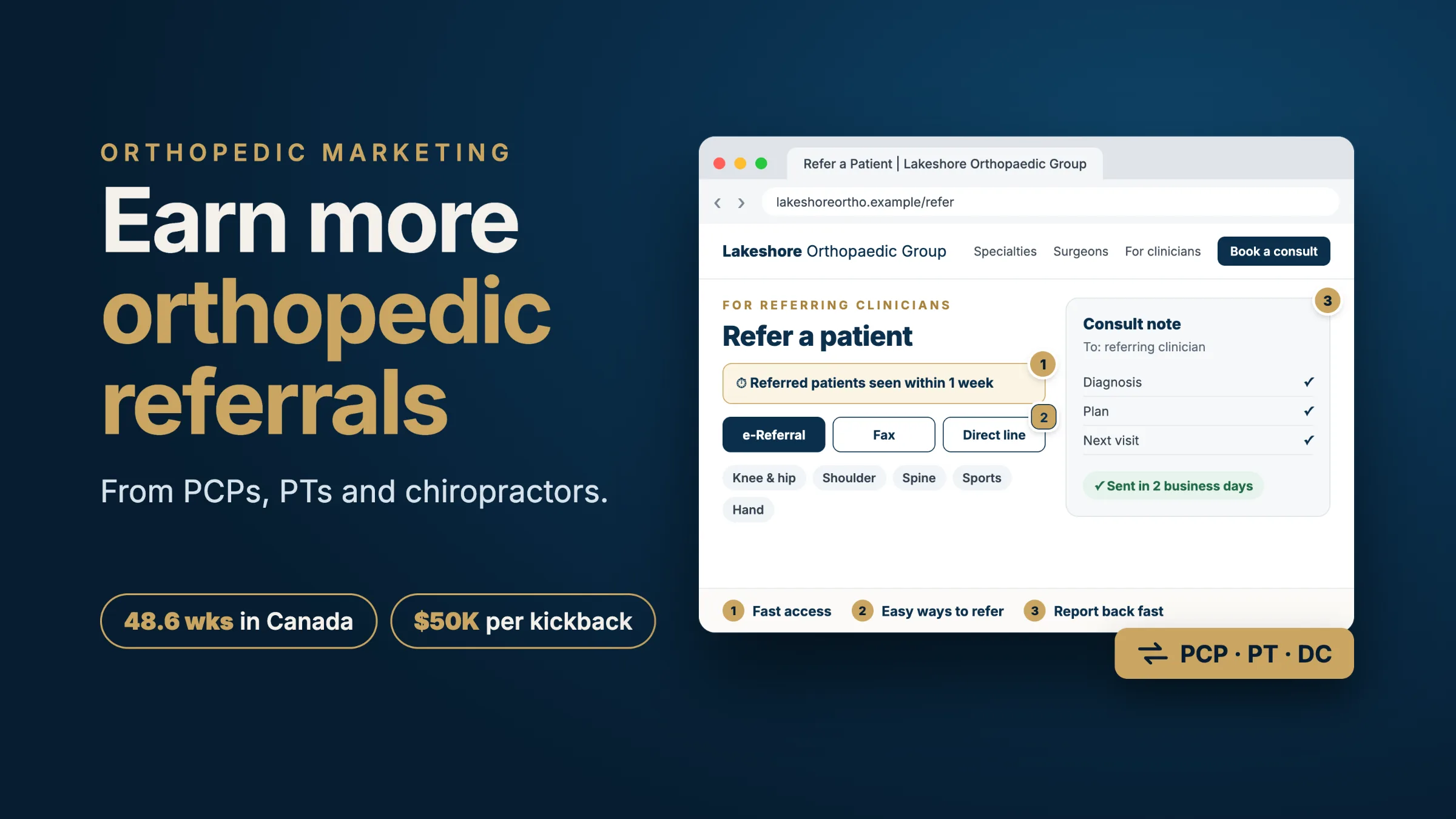
The Fraser Institute's Waiting Your Turn 2025 report put the median wait from a GP referral to treatment at 28.6 weeks across all specialties, and at 48.6 weeks for orthopaedic surgery. The first step alone, from GP referral to the specialist consult, had a median of 15.3 weeks.
So in Canada, referral marketing is less about getting noticed and more about being the practice family doctors trust to handle the referral well. That means accurate wait-time information, clear routing to the right subspecialty, and a referral form that doesn't bounce back for a missing field. Family doctors remember which offices make their lives harder.
If you take referrals through a central intake program or e-referral system in your province, make sure your profile there is current: subspecialties, conditions you treat, and realistic wait times. Referrers often choose from that list, not from your website.
How do you earn more primary care referrals?
Make referring to you faster and less risky than referring anywhere else. Primary care doctors are juggling dozens of problems in a 15-minute visit; they send patients to the office they trust to see them quickly and report back.
- Protect access. Hold a few same-week slots for referred patients, and say so on your referral page. Nothing builds loyalty faster than a patient telling their doctor "they saw me Thursday."
- Publish referral criteria. A one-page guide per subspecialty: what to send, what imaging helps, what can wait, and what needs a same-day call. It cuts bad referrals and shows you value their time.
- Close the loop in 48 hours. A short consult note with the diagnosis and plan, sent within two business days. Referrers judge you on this more than on anything you say.
- Give them a direct line. A number or secure message route that reaches a clinical person, not the general phone tree.
- Visit with substance. A 10-minute in-person or virtual update from a surgeon or PA on a new procedure or pathway beats a branded pen every time.
How should you work with physical therapists?
Treat PTs as partners who often see patients first. They decide when a patient isn't improving and needs a surgical opinion, so they're one of your most valuable referral sources.
According to the American Physical Therapy Association, patients in all 50 states and DC have some form of direct access to physical therapists, although some states still limit treatment without a referral. In practice, that means plenty of knee, shoulder and back patients walk into a PT clinic before they ever see a physician.
What PTs want is simple. Respect their plan of care, explain your findings in language they can use, and give them a way to ask "is this worth an MRI?" without a full referral. When a patient needs rehab after surgery, the patient chooses their PT; if they want to go back to the clinic that referred them, make that easy. Don't make it a condition of anything.
What about chiropractors?
Chiropractors see a lot of back and neck pain early, so for spine and general orthopedic practices they can be a meaningful source. The relationship works when it's clinical and professional. (For the patient's side of this path, see our guide to the spine surgery patient journey.)
Give chiropractors clear red-flag guidance (progressive weakness, bowel or bladder changes, unexplained weight loss, trauma) and a fast triage path when they see one. Explain what you need in a referral and what imaging, if any, helps. A short, respectful consult note back goes a long way, especially if you've ever been tempted to treat chiropractic referrals as second-class. Referrers can tell.
What can't you do when marketing to referrers?
You can't give anything of value to induce referrals. In the US, this is criminal law, not etiquette. General information, not legal advice; talk to healthcare counsel before any referral program.
The HHS Office of Inspector General's guide to fraud and abuse laws explains that the federal Anti-Kickback Statute bars knowingly offering or paying anything of value to induce or reward referrals of federal health care program business. Civil penalties can reach $50,000 per kickback plus three times the remuneration. The Stark law separately restricts physicians from referring Medicare and Medicaid patients for certain services, including imaging and physical therapy, to entities they have a financial relationship with, unless an exception applies.
Red flags to avoid: paying per referral, free services or staff for a referring office, "marketing fees" tied to volume, lavish meals or tickets, swapping referrals with another practice on a quid pro quo basis, and gift cards of any size. If a tactic only works because the referrer gets something, it's the wrong tactic.
In Canada, provincial colleges set conduct rules. Ontario's CPSO advertising policy also bans patient testimonials in physician advertising, which matters if you plan to share patient stories in referral materials.
How do you make referring easy on your website?
Build one page for referring clinicians and link it from your footer. It should answer every question a referring office asks on the phone.
- How to refer: fax number, e-referral or secure form, and what to include.
- Who does what: each surgeon's subspecialty and the conditions they see.
- Access: current new-patient wait and urgent-slot options.
- Locations, hours and the direct line for referring clinicians.
- Downloadable referral criteria for each subspecialty.
This page also helps patients. Many search "do I need a referral to see an orthopedic surgeon" before booking, and a clear answer keeps them on your site. Pair it with condition pages for your main procedures; our guide to getting more joint replacement patients shows how those pages should be built. When referred patients call, answer fast. A Harvard Business Review study found firms that contacted leads within an hour were about seven times more likely to qualify them than firms that waited longer; referred patients are no different.
How do you track which referrers send patients?
Capture the referring provider on every new patient, then review it monthly. If you can't see who sends patients, you can't thank them, spot a drop, or tell which outreach worked.
- Make "referring provider" a required field at intake, with "self, Google, ad, friend" options for self-referred patients.
- Report monthly: new patients by referrer, by subspecialty, and by whether they booked surgery.
- Flag any referrer whose volume drops by half over a quarter, and find out why. It's often an access or communication problem you can fix.
- Send a thank-you consult note, not a gift. The note is the thank-you.
What does a 90-day referral plan look like?
Fix access and communication first, then build materials, then reach out. Outreach before the basics are fixed just sends more people into a slow process.
| Weeks | Focus | Actions |
|---|---|---|
| 1 to 2 | Data | Pull 12 months of referrals; list top 25 referrers and the ones who went quiet |
| 3 to 4 | Access | Hold same-week slots for referred patients; set the 48-hour consult note rule |
| 5 to 6 | Materials | Referral page on the website; one-page criteria per subspecialty; direct line |
| 7 to 10 | Outreach | Short visits or virtual updates with top and lapsed referrers; PT and chiropractor triage guidance |
| 11 to 13 | Review | Compare referrals by source against the baseline; fix whatever slowed patients down |
Referrals and online marketing feed each other. Patients who get a referral still look you up, so your Google profiles, reviews and condition pages close the deal. Our orthopedic surgeon marketing page shows how the online side fits together, and how surgeons get more patients covers the other channels.
Frequently asked questions
What is orthopedic referral marketing?
It is the work of making your practice the easiest and most trusted place for other clinicians to send patients. That means fast access for referred patients, clear referral criteria, quick consult notes back to the referrer, a simple way to refer online, and tracking which referrers send whom. It never means paying for referrals.
Who refers the most orthopedic patients?
Primary care physicians and nurse practitioners are usually the biggest source, followed by physical therapists, urgent care and emergency physicians, chiropractors and sports medicine doctors. Your own mix depends on your subspecialties, so pull the referring-provider field from your practice software before you plan anything.
Can we give gifts or meals to doctors who refer to us?
Be very careful. In the US, the federal Anti-Kickback Statute makes it a crime to give anything of value to induce referrals of federal health care program business, and the Stark law limits referrals tied to financial relationships. Small educational lunches and nominal items may be allowed in some cases, but get advice from healthcare counsel before any program. General information, not legal advice.
Do physical therapists need a doctor's referral in the US?
Not always. According to the American Physical Therapy Association, patients in all 50 states and DC have some form of direct access to physical therapists, though some states still limit treatment without a referral. That is why PTs often see knee, shoulder and back patients before any doctor does.
How long does it take to grow referrals?
Expect three to six months before a new referral relationship shows up as steady volume. Fast fixes, like same-week slots for referred patients and consult notes within two days, can change how referrers feel within a few weeks.
The bottom line
Referring clinicians send patients to the practice that sees them quickly, reports back fast and makes referring painless. Fix access and consult notes first, publish a referral page and clear criteria, then reach out with something useful. Track every referrer so you notice when one goes quiet. And keep it clean: the only reward a referrer should get is a well-treated patient. If you want a second opinion on how your site handles referrals, request a free practice growth audit.
General information, not legal or medical advice. Rules change, so confirm anything compliance-related with your own advisor and your state board or provincial College.