Neither one wins on its own. Google Ads bring patients quickly but stop the moment you stop paying. SEO takes months to build, then brings steady patients at a lower cost each. Most surgical practices that grow use both: ads for speed today, SEO for lasting results. The right balance depends on how fast you need patients and how much you can spend.
Both are part of a wider set of channels surgeons use to grow, but they are usually the two biggest line items, so getting the balance right matters.
Trying to decide where your marketing money should go? Contact us for a free practice growth audit, and we will show you the right split for your specialty and city.
SEO vs Google Ads: the quick answer
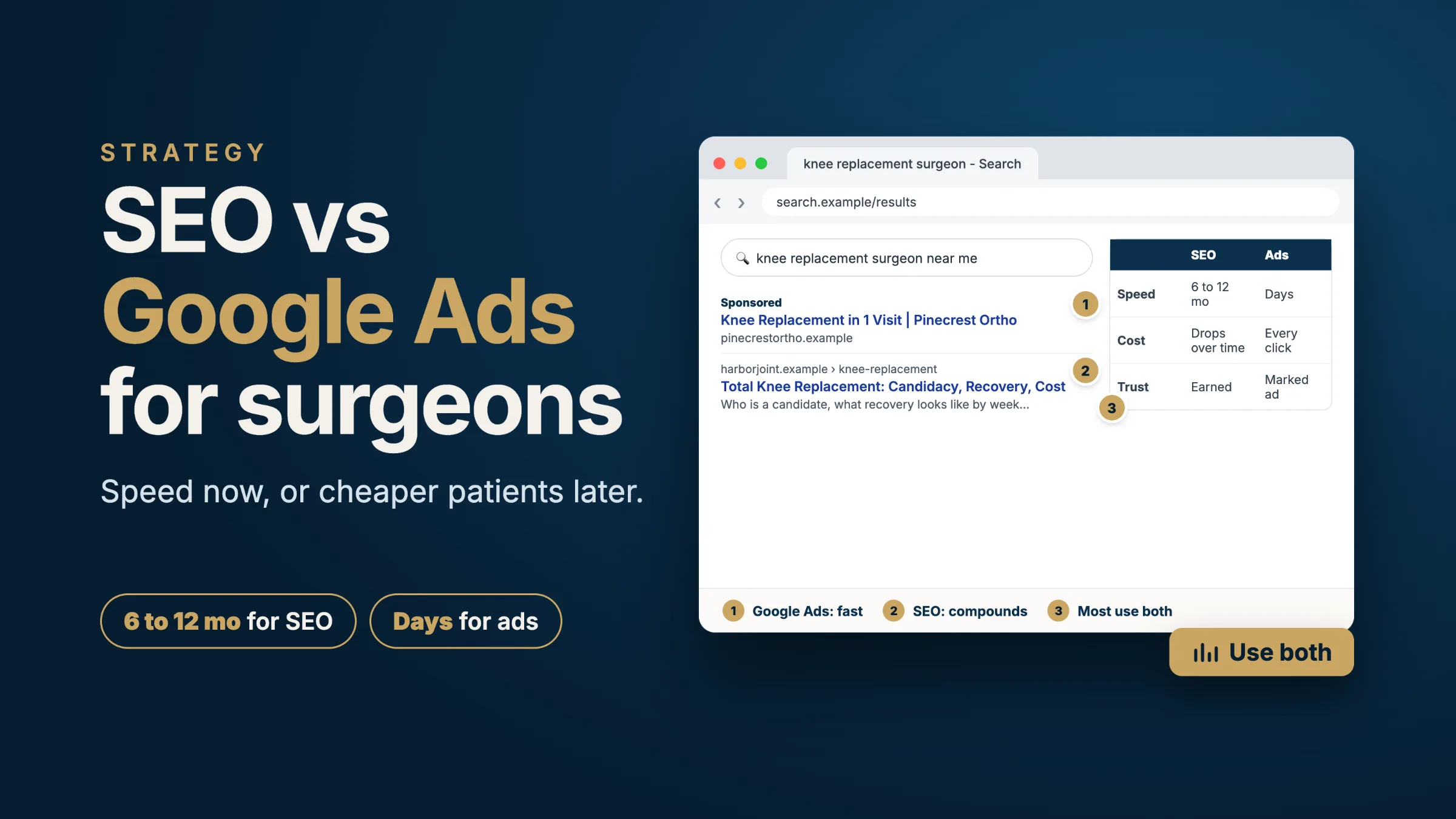
If you need patients this month, Google Ads win. If you want lower-cost, steady patient flow over the next year, SEO wins. Here is the side-by-side.
| Factor | SEO | Google Ads |
|---|---|---|
| Speed to first patients | 6 to 12 months | Days to weeks |
| Cost pattern | Higher upfront, lower per patient over time | Pay for every click, ongoing |
| Where you show up | Map pack and free results | Top ads, above the free results |
| What patients think | Seen as more earned and trusted | Clearly marked as sponsored |
| When you stop paying | Rankings hold for a while | Traffic stops the same day |
| Best for | Long-term, steady, lower-cost growth | Fast results, new practices, single procedures |
What is SEO for surgeons?
SEO, or search engine optimization, is the work of getting your pages to show up in Google's free results when patients search for the procedures you perform. Someone searching "hernia surgeon in Phoenix" finds your page without you paying for the click. It covers your website content, procedure pages, your Google Business Profile, page speed, and the reviews and links that build trust.
SEO for surgical practices is slow to start, because Google takes time to trust a new site, but the patients it brings cost less over time. The pages keep working after you stop active work, which is why the results compound.
A quick example makes it clear. If you publish a strong page on "rotator cuff surgery recovery" and it ranks, it can bring patients for years from one piece of work. You are not charged when someone reads it or calls. That is the appeal of SEO: the cost sits upfront, and the return stretches out over time.
The trade-off is patience. You may wait 6 to 12 months for strong results, and in a competitive city it takes steady effort. Once you rank, though, you are not paying for each patient, and the trust that comes with a top organic spot is hard to buy.
What are Google Ads for surgeons?
Google Ads are the paid listings at the very top of the search results, marked as sponsored. You bid to appear for searches like "knee replacement near me," and you pay only when someone clicks. A managed Google Ads program can put you in front of high-intent patients within days, which makes it the fastest way to fill a schedule.
You control the budget, the message, and exactly which searches you target. That control is the main reason new practices start here.
Here is the same idea in practice. If you run ads for "LASIK near me" with a $5,000 monthly budget, you can book consults this week, but those consults stop the day the budget runs out. There is no lasting asset, only the patients you paid for that month.
The catch is that the patients stop the moment the budget does. You are renting the top spot, not owning it. Clicks in surgery can be expensive, because patient value is high and competitors bid too, so tight targeting and a strong landing page decide whether you make money or waste it.
A closer look at the differences
Speed and cost
Ads are fast and ongoing. You can turn them on today and see calls this week, but you pay for every click, every month. SEO is slow and cumulative. It may take most of a year to build, then costs less per patient because you are no longer paying for the click.
Trust and clicks
Many patients skip past the ads and click the first few free results, which they see as more earned. Ads still work well for high-intent searches, where the patient wants a surgeon now and is happy to click the top result. Both have their place.
Control and risk
Ads give you fast, clear data on which searches lead to booked consults, and you can change course in a day. SEO gives you less control and slower feedback, but far less risk of a sudden cost spike. Smart practices use the data from ads to decide which pages to build for SEO.
Competition
In a busy metro, the top ad spots for elective procedures are expensive, and ranking organically is hard because every competitor is trying too. In a smaller market, both are easier and cheaper, and a well-optimized Google Business Profile alone can win a large share of local searches. Your city shapes the answer as much as your specialty does.
Not sure whether to start with SEO, ads, or both? Talk to our team and we will build a plan around your timeline and budget.
Which one should your practice choose?
The right choice depends on where your practice is today.
A new practice usually starts with Google Ads for speed, while SEO builds in the background. An established practice with time to invest gets more from SEO, which lowers the cost of each new patient over the long run. A competitive elective field, like plastic surgery or LASIK, often needs both: ads to compete now, and SEO so you are not paying for every patient forever. On a tight budget, pick one and do it well, usually local SEO paired with a small, focused ad budget on your most profitable procedure.
If you still cannot decide, ask one question: how long can you wait for patients? If the answer is weeks, lead with ads. If it is months, and you want lower costs later, lead with SEO. Most practices land somewhere in the middle and run both at a ratio that shifts toward SEO as rankings grow.
Why most surgeons use both
The practices that grow fastest rarely choose one. They run ads to bring patients now, then use the keyword data from those ads, the exact searches that lead to booked consults, to guide their SEO. As rankings climb, they lower ad spend on terms they now rank for and move that money to new procedures.
Ads and SEO also share the same foundation. Both send patients to a website that turns clicks into consults, so a weak website wastes money on either one. Fix the website first, and both channels perform better.
A common mistake surgeons make
The biggest error is treating this as a one-time pick and then forgetting it. A practice pours everything into ads, grows comfortable, and never builds the SEO that would lower costs later, so it keeps paying full price for every patient for years. Others buy SEO, see nothing for three months, and quit right before it starts to work. Both channels reward patience and tracking. Decide your split, measure which one books real consults, and adjust every quarter instead of guessing.
How much does each cost?
Google Ads cost is ongoing and predictable. You set a monthly budget and pay per click, so you can start or stop anytime. SEO is more like an investment that builds, with most of the cost upfront in content and technical work, then lower costs to maintain.
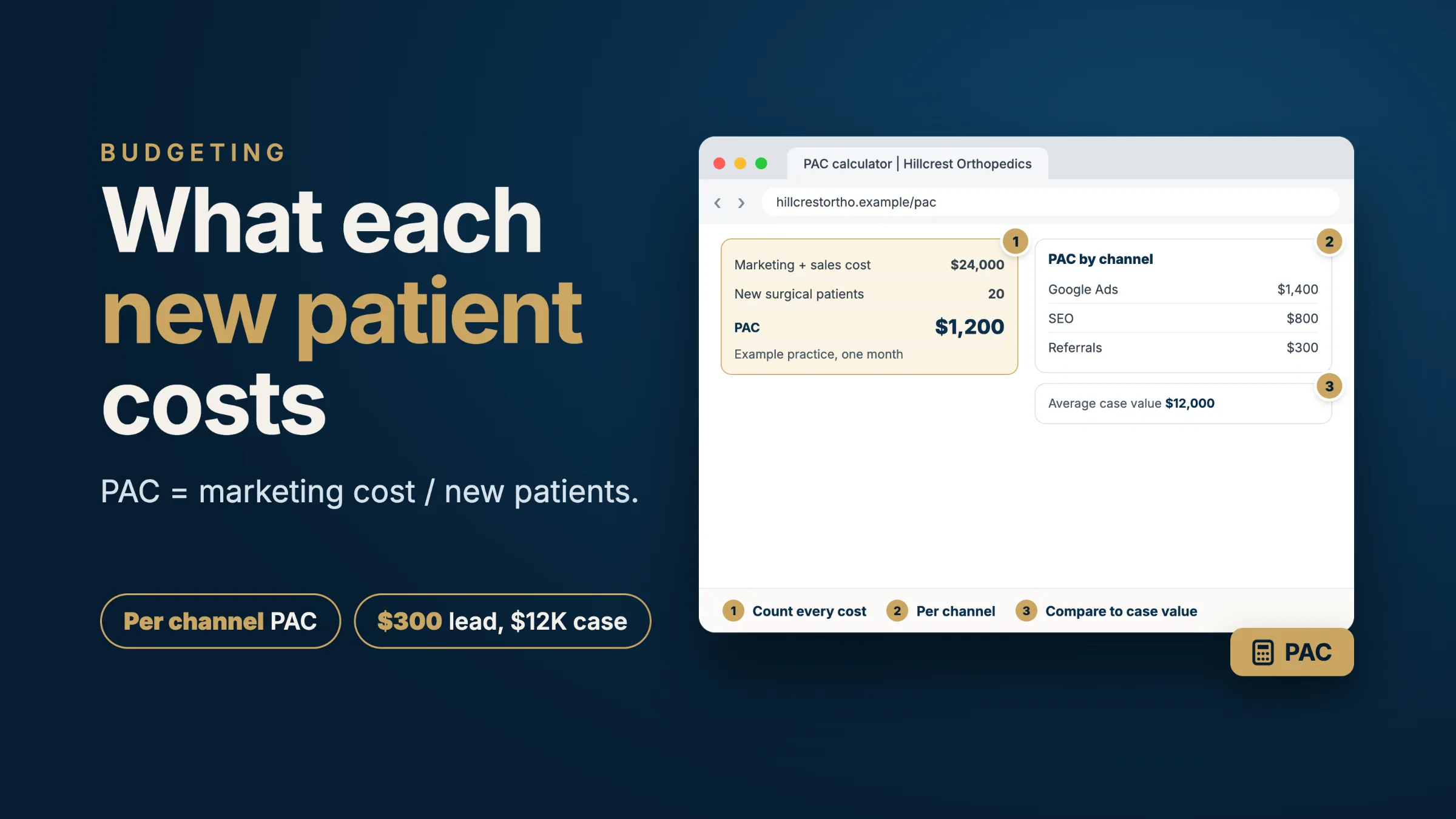
Neither has a fixed price, because it depends on your city, specialty, and competition. Before you split your money between them, it helps to plan your marketing budget as a share of revenue, then decide how much goes to fast results versus long-term growth. Whichever you pick, the spend is wasted if no one answers the phone, so consistent follow-up on every lead is what turns clicks into booked surgeries.
Frequently asked questions
Is SEO or Google Ads better for surgeons?
Neither is better on its own. Google Ads bring patients fast but stop when you stop paying, while SEO takes longer but brings steady, lower-cost patients. Most practices use both.
How long does SEO take for a surgical practice?
Usually 6 to 12 months for strong results, though low-competition terms can rank sooner. Google needs time to trust a site before it ranks well.
Are Google Ads worth it for surgeons?
Yes, when they are targeted tightly and paired with a strong landing page. High patient value can easily cover high click costs if the campaign is run well.
Can you run SEO and Google Ads at the same time?
Yes, and it is the most common approach. Ad data improves your SEO targeting, and SEO lowers your ad costs over time as you start ranking for free.
What is cheaper, SEO or Google Ads?
SEO usually costs less per patient over time, while ads cost more per patient but bring them faster. The cheapest option depends on how long you can wait.
The bottom line
There is no single winner. Google Ads buy you speed, SEO builds lasting and lower-cost growth, and together they cover both. Start with the one that fits your timeline and budget, then add the other as you grow. You can see how SEO and paid campaigns play out for healthcare practices in our case studies. The best choice is the mix that brings booked patients at a cost your practice can sustain.
Want a clear plan for SEO, Google Ads, or both? Get in touch and we will map the fastest path to more surgical patients.
General information, not legal or medical advice. Rules change, so confirm anything compliance-related with your own advisor and your state board or provincial College.