To get more joint replacement patients, win the months of research that come before the consult. Build a page for each joint that covers symptoms, non-surgical options, outpatient candidacy and recovery, give every joint surgeon a Google profile with steady reviews, feed the referral network that sends you patients, aim Google Ads at replacement and second-opinion searches, and call every inquiry back the same day.
Joint replacement is a slow decision. Most patients live with knee or hip pain for years, try physical therapy and injections, ask friends who had surgery and read everything they can find before they book. Many bring a spouse or an adult child to the first visit. The practice that helps them at every step of that process, and is easy to reach when they're finally ready, gets the case.
Want to see where your practice loses joint patients? Our orthopedic surgeon marketing team starts with a free video audit of your joint pages, surgeon profiles and referral path, delivered in 2 business days.
How do joint replacement patients choose a surgeon?
They choose over months, not days, and usually with help. A typical path starts with symptom searches, moves through a non-surgical clinician, and ends with the patient comparing two or three surgeons by reputation, experience and convenience.
Here's the pattern we see most often:
- Living with the pain. Searches like "knee pain going down stairs" or "hip pain when walking," plus a lot of reading about arthritis.
- Conservative care. Primary care, physical therapy, injections. This is where the referral relationship decides which surgeon's name they hear.
- The X-ray conversation. Someone says "bone on bone," and the searches change to "do I need a knee replacement" and "partial vs total knee replacement."
- Comparing surgeons. Reviews, surgeon bios, hospital or surgery center, insurance and how soon they can be seen. Family members join in here.
- Booking. Whoever answers the phone, explains the next step and offers a reasonable date usually wins.
Most practices only show up at step four. The ones that grow show up at every step.
How big is the joint replacement market right now?
Big and still growing, which is why so many groups compete for it. The American Joint Replacement Registry's 2025 annual report analyzed more than 4.4 million hip and knee arthroplasty procedures performed from 2012 through 2024, from all 50 states, and its data grew 8.8% over the previous year.
Where the surgery happens is shifting too. CMS removed total knee replacement from the Medicare inpatient-only list for 2018, then added total knee to the ASC covered procedures list for 2020 and total hip for 2021. That gives your marketing a story to tell: who can go home the same day, and who shouldn't.
More competition means visibility alone isn't enough. Your pages, profiles and follow-up have to be better than the group across town.
Which searches should your joint replacement pages answer?
Every stage of the journey has its own searches, and each one needs a page that answers it. A single "joint replacement" page can't do that job.
| Stage | Example searches | The page that answers it |
|---|---|---|
| Symptoms | knee pain going down stairs, hip pain when walking, groin pain hip | Condition pages for knee and hip arthritis with causes and non-surgical options |
| Diagnosis | bone on bone knee, hip arthritis treatment, do I need a knee replacement | "When is it time for surgery?" pages that are honest about alternatives |
| Options | partial vs total knee replacement, anterior hip replacement, robotic knee replacement | Procedure pages for each approach your surgeons actually use |
| Logistics | outpatient knee replacement, knee replacement recovery time, does Medicare cover hip replacement | Outpatient candidacy, recovery by week, insurance and prior authorization |
| Choosing | best knee replacement surgeon near me, hip replacement surgeon [city], second opinion knee replacement | Surgeon bios, Google profiles, reviews and an easy second-opinion request |
The search phrases above are typical patterns, not volume data. Check your own Search Console queries to see which ones already bring people to your site.
What should a knee or hip replacement page include?
A good page answers what a patient and their family would ask on the first call. If it doesn't, they keep reading somewhere else.
- Who it's for, and when non-surgical care should come first.
- The approaches you offer, such as partial or total knee, anterior or posterior hip, robotic assistance, explained without overclaiming.
- Where surgery happens: hospital, ASC or both, and who qualifies for outpatient surgery.
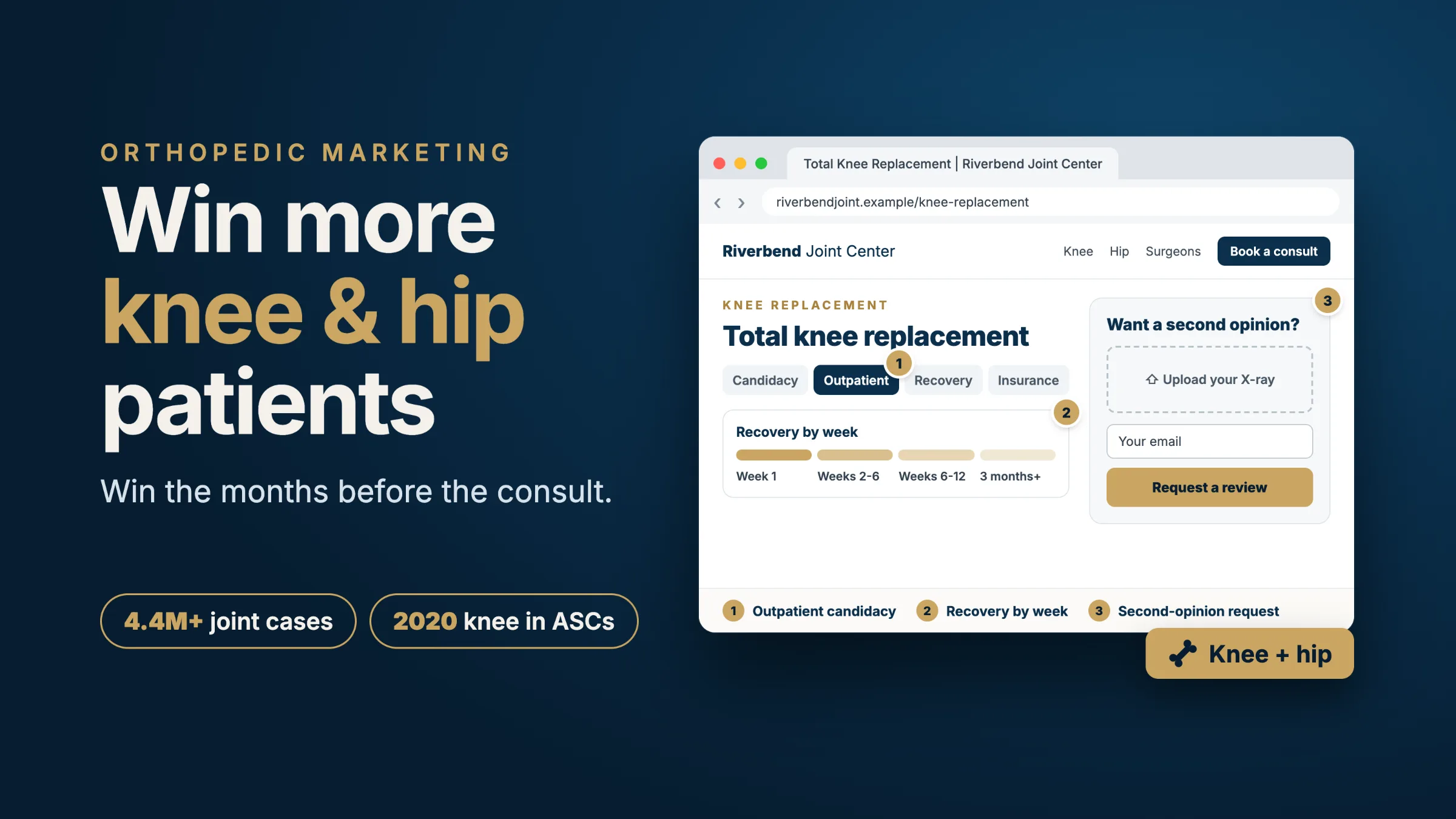
- Recovery week by week: walking aids, driving, stairs, return to work, physical therapy.
- Risks and results, stated plainly. Patients trust pages that don't pretend surgery is risk-free.
- The surgeon: training, focus on joints, and procedure volumes only if you can document them.
- Insurance: Medicare, the commercial plans you accept, and how prior authorization works.
- A clear next step: request an appointment, send imaging, or ask about a second opinion.
Write separate pages for knee and hip, and for partial and total knee if your surgeons do both. Google ranks pages, and patients search for specific procedures.
How do you get more joint replacement referrals?
Make your practice the easiest one to refer to and the best at reporting back. Referrers send patients to whoever schedules fast, communicates clearly and returns the patient for rehab.
Physical therapists deserve special attention. According to the American Physical Therapy Association, all 50 states and DC allow some form of direct access to physical therapy, so a PT is often the first clinician who examines an arthritic knee. A referral relationship with nearby PT clinics can matter as much as your website.
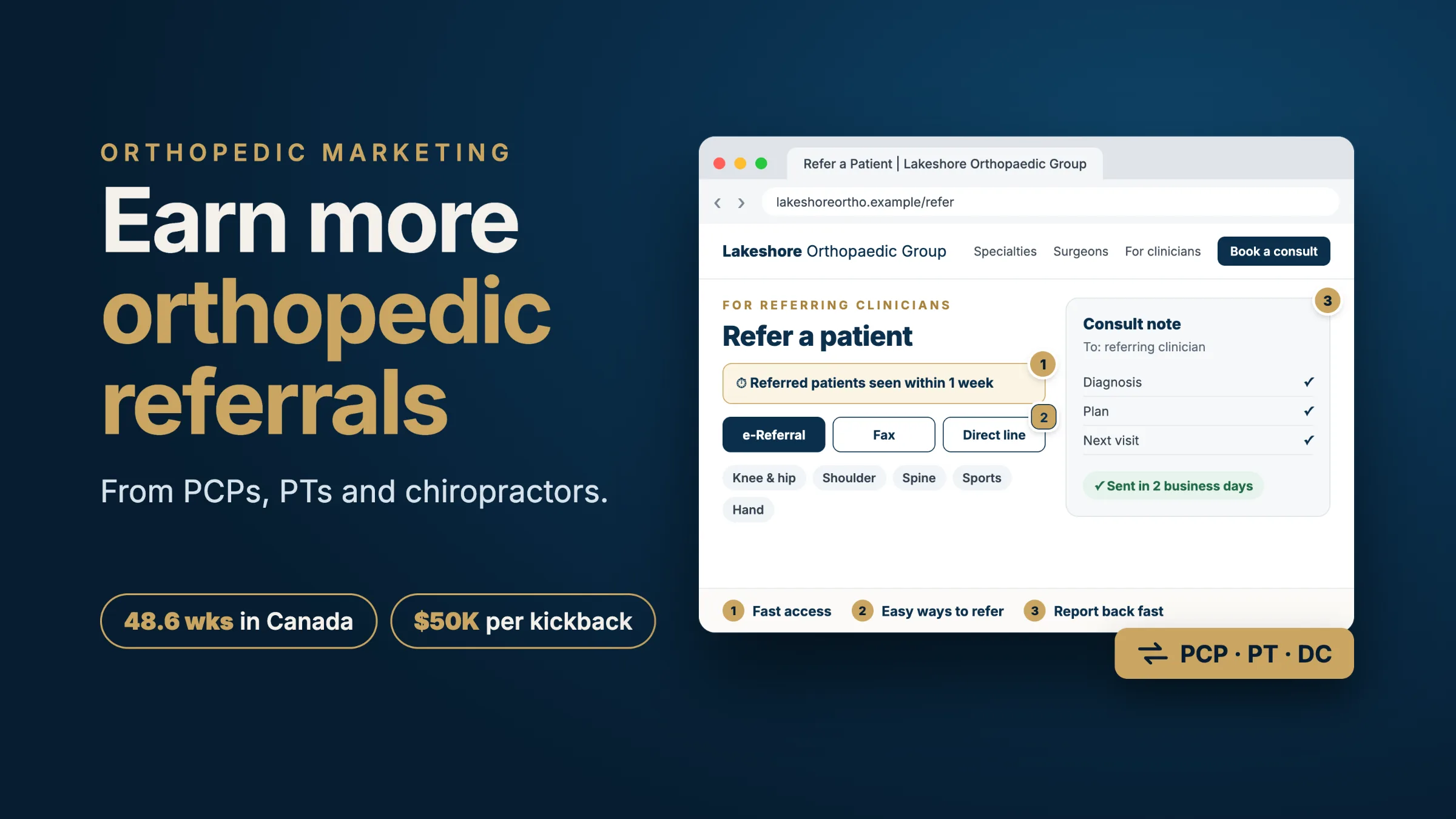
- A referral page with fax, e-referral and phone options, and what happens after a referral.
- Protected appointment slots so referred patients are seen quickly.
- Consult notes back to the referrer within days, with a named contact.
- Surgeon visits and short education sessions at primary care and PT offices.
- Monthly tracking of referrals by source, so you notice when one goes quiet.
Keep it legal. The federal Anti-Kickback Statute and Stark law limit what you can offer referral sources, as HHS OIG explains. Education and convenience are fine. Payments, gifts or perks tied to referrals are not.
Should you market outpatient and ASC joint replacement?
Yes, if your surgeons offer it, because patients now search for it by name. Just be clear about who qualifies, since outpatient surgery isn't right for everyone.
A strong outpatient page explains the candidacy factors your surgeons use, what happens on surgery day, how pain and mobility are managed at home, and what support the patient needs from family. It should also say when the hospital is the safer choice. That honesty builds trust with patients and with the primary care doctors who read your pages before they refer.
Not sure which joint pages are missing? Get a free surgeon marketing audit. We check your knee and hip pages, surgeon profiles and booking flow, and send a short video in 2 business days.
Do Google Ads work for joint replacement?
They can, when they're narrow. Aim at replacement, surgeon and second-opinion searches in your area, and stay away from broad "knee pain" terms that mostly reach people who need physical therapy first.
Two rules shape every campaign. First, Google's personalized advertising policy treats invasive medical procedures as a sensitive category, so you can't use remarketing lists, Customer Match or lookalikes for surgical services. Your landing page has to work on the first visit. Second, costs add up. WordStream's 2026 benchmarks put the median physicians and surgeons search CPC at $4.76 and the median cost per lead at $40.04, and competitive metro joint terms often run higher.
- Separate campaigns for knee, hip and second opinions, each with its own page.
- Exclude terms like "exercises," "brace," "cheap" and "jobs," and plans you don't accept.
- Track booked consults and surgeries, not just form fills.
- Run ads only when someone can answer the phone or book online.
Our guide to the Google Ads healthcare policy for surgeons covers the certification and targeting rules in more detail.
How do reviews and surgeon profiles affect bookings?
They decide who makes the shortlist. Joint patients and their families read reviews closely, and Google counts reviews toward the prominence part of its local ranking factors.
In a group practice, give each public-facing joint surgeon a Google Business Profile. Google's practitioner guidelines allow it, and it lets a hip surgeon rank for "hip replacement surgeon near me" with reviews that name them. Ask every patient for a review at the right moment, such as a follow-up visit when they're walking well, and never offer incentives or ask only happy patients. Google's review policy bans both, and the FTC's 2024 rule bans fake and suppressed reviews. Our Google Business Profile checklist for surgeons walks through categories, services and photos.
How fast should you follow up with a joint replacement lead?
The same day, and within an hour if you can. A Harvard Business Review study found that firms contacting leads within an hour were about 7 times as likely to qualify them as firms that waited longer.
Joint patients also need a different kind of call. They often want to talk about insurance, imaging, time off and who will help at home, and many prefer the phone to a form. Train whoever answers to handle those questions, offer to book the family into the first visit, and follow up more than once before marking a lead lost.
What should you track to know it's working?
Track cost per booked consult and cost per surgery by source, including referrals. Website traffic and form fills can rise while surgeries stay flat.
At minimum, record where every new joint patient came from, whether they booked, whether they had surgery, and which surgeon they saw. After three months you'll know which channels, pages and referrers actually fill the OR schedule, and you can move budget accordingly.
Frequently asked questions
What is the best way to get more joint replacement patients?
Win the long research phase and the referral network at the same time. Publish a page for each joint that covers symptoms, non-surgical options, outpatient candidacy and recovery, give every joint surgeon a Google profile with steady reviews, keep PTs and primary care informed, and call every inquiry back the same day.
Should we market outpatient joint replacement?
Yes, if your surgeons offer it, and be honest about who qualifies. CMS took total knee replacement off the Medicare inpatient-only list for 2018 and added total knee and total hip to the ASC covered list for 2020 and 2021. Patients now ask about going home the same day, so a page that explains candidacy, safety and recovery answers a real search.
Do Google Ads work for knee and hip replacement?
They can, if campaigns are narrow. Target replacement, surgeon and second-opinion searches in your service area, exclude plans you don't accept, and send each ad to a page about that joint. Google treats surgical procedures as a sensitive category, so remarketing lists and Customer Match are not allowed and the landing page has to work on the first visit.
How do we get more referrals from physical therapists?
Make referring easy and report back fast. A referral page with fax, e-referral and phone options, quick scheduling, consult notes within days and regular in-person visits to nearby PT clinics all help. Stay inside the Anti-Kickback Statute: education and convenience are fine, payments or perks for referrals are not.
How long does it take to see results?
Google profile work and review growth can move map rankings within a few months. New condition and procedure pages usually take several months to rank in a competitive market. Referral growth depends on how consistently you follow up with referrers, and Google Ads can produce consults within weeks.
The bottom line
Joint replacement patients are won over months, by the practice that helps them understand their options and is easy to reach when they're ready. Build honest pages for each joint, give every surgeon a strong Google profile, look after the PTs and doctors who refer, keep ads narrow and call back fast. That combination beats a bigger budget spent on generic orthopedic ads.
General information, not legal or medical advice. Rules change, so confirm anything compliance-related with your own advisor and your state board or provincial College.