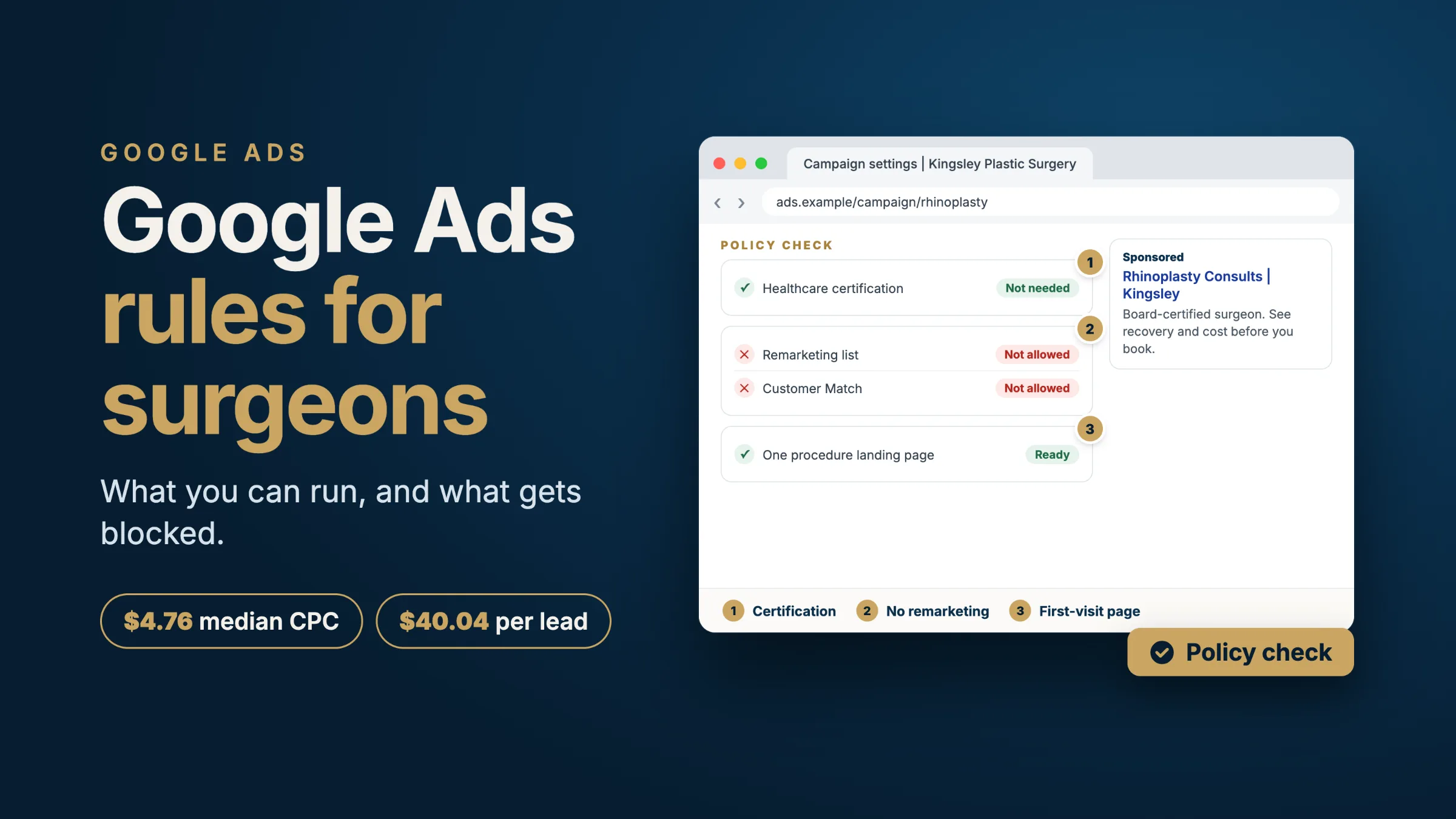
Most surgical practices can advertise on Google without any healthcare certification. Google requires certification for online pharmacies, prescribing telemedicine, addiction treatment, drug makers and health insurance, not for in-person surgery. What actually limits surgeons is targeting: Google treats invasive procedures as a sensitive category, so remarketing and customer lists are off, and drug terms and imagery carry extra rules.
Why it matters: surgical practices lose weeks to disapproved ads and suspended campaigns, usually because nobody read the policy before launch. Others assume restrictions that don't exist and skip Google Ads altogether. Both are expensive mistakes in a category where WordStream's 2026 data puts the median cost per lead for physicians and surgeons at $40.04, versus $66.69 across all industries.
Getting disapprovals or worried about policy? Our Google Ads management for surgeons is built around these rules from day one.
Do surgeons need Google Ads healthcare certification?
Usually no. Certification is tied to specific business types, and a practice promoting in-person consultations and surgery isn't one of them.
Google's Healthcare and medicines policy says advertisers must be certified to promote online pharmacies, prescription drug services, pharmaceutical manufacturers, addiction services and health insurance. Its prescription drug services page describes these as services related to online prescribing, dispensing and sale of prescription drugs, and says Google errs on the side of caution when a landing page appears to facilitate that.
Where surgeons do bump into certification:
- Telehealth prescribing, such as online GLP-1 weight loss programs run alongside a bariatric practice. In the US, telemedicine providers need LegitScript accreditation before Google will certify them.
- Bidding on prescription drug keywords, like a brand-name injectable. Certification is required for keyword targeting of those terms in the US and Canada.
- Addiction or recovery services offered by a pain or spine program. These need LegitScript addiction treatment certification plus Google certification.
If none of those apply, you don't need LegitScript. Paying for it "just in case" is a common upsell and rarely needed for a pure surgical practice.
What surgical services can you advertise on Google?
You can advertise consultations and established surgical procedures freely, as long as claims are accurate and the procedure isn't experimental. The bans that matter are speculative treatments and unapproved substances.
| What you want to promote | Google's position | Certification? |
|---|---|---|
| Consultations, established surgical procedures | Allowed | No |
| Cosmetic surgery (breast, body, face) | Allowed; sexual content rules apply to imagery | No |
| Prescription drug names in ads or landing pages (US, Canada) | Allowed if compliant with local law | No for ads; yes to bid on those keywords |
| Online prescribing or telehealth (e.g. GLP-1 programs) | Restricted | Yes; LegitScript in US and Canada |
| Addiction treatment | Restricted | Yes; LegitScript plus Google |
| Speculative or experimental treatments | Not allowed | Not available |
| Cell and gene therapies (incl. many stem cell offerings) | Generally not allowed; narrow US exception for FDA-licensed products | By exception only |
The experimental-treatment ban catches more orthopedic and spine practices than you'd expect. If you promote regenerative injections or "stem cell" joint treatment, Google may treat it as speculative or as a cell therapy, and the ad won't run. Promote the established procedures and keep newer options as information on your site.
Why can't surgeons use remarketing or Customer Match?
Because Google classifies invasive medical procedures, including cosmetic surgery, as a sensitive health category under its personalized advertising policy. That rules out every audience you build from your own data.
Google's Health in personalized advertising page lists "invasive medical procedures, including cosmetic surgery, surgical procedures, or injections" as personal health content. For those ads, Customer Match, your data segments (remarketing lists), audience expansion and lookalike segments can't be used. Custom segments are limited too.
What still works:
- Search keywords, which do most of the work for surgeons anyway.
- Location and radius targeting around your practice.
- Google's own predefined audiences, such as in-market and affinity segments.
- Conversion tracking and Smart Bidding based on anonymous conversion events.
Our view: losing remarketing hurts less than people think for surgical search campaigns. Someone searching "tummy tuck surgeon near me" has already told you what they want. The bigger loss is on Demand Gen and Display, where Google may block sensitive ads that rely on your own audience lists.
How do Google's drug term and imagery rules affect surgeons?
Prescription drug names are now allowed in US and Canadian ads, but targeting them as keywords needs certification. Nudity in ad images, including before-and-after shots, falls under Google's sexual content policy and limits where ads can serve.
Drug terms. Google's October 2025 healthcare policy update, enforced from October 29, 2025, lets campaigns targeting the US, Canada and New Zealand use prescription drug terms in ads and landing pages for promotion, in line with local law. Keyword targeting of those terms still requires certification. For an aesthetic practice, that means "Botox" can appear in the ad text, but bidding on the keyword needs certification. Many practices use generic terms like "wrinkle relaxer injections" in keywords for that reason.
Imagery. Google's sexual content policy treats visible breasts, buttocks or genitalia, even blurred, as nudity, and partial nudity as moderately restricted. Those ads serve based on age, local law and SafeSearch, and can't run on the Display Network or YouTube. Cosmetic surgeons should keep ad images non-revealing and show results on the landing page instead.
Claims. Superlatives like "best," "painless" or "guaranteed results" invite disapprovals and, more importantly, trouble with your medical board or College. Write the ad the way you'd defend it to a regulator.
What's different for surgeons advertising in Canada?
Google's policies are mostly the same in Canada, but Canadian drug advertising law and provincial College rules are stricter than US rules. Those, not Google, are usually the binding constraint.
- Prescription drug advertising: under section C.01.044 of the Food and Drug Regulations, consumer advertising of a prescription drug is limited to its name, price and quantity. Google may allow "Botox" in an ad, but federal law limits what you can say about it.
- Telemedicine and pharmacies: Google allows Canadian online pharmacies and telemedicine providers with limits, if accredited by LegitScript (or NABP for pharmacies).
- Testimonials and before-and-afters: the CPSO advertising policy bans patient testimonials in Ontario physician advertising and sets conditions for before-and-after images. It also holds the physician responsible for ads an agency runs.
- Privacy: health-based ad targeting needs express consent under Canadian privacy law. Our guide to HIPAA and PIPEDA compliant marketing covers the details.
What gets surgical ads disapproved most often?
In the accounts we review, most disapprovals come from a handful of repeat causes, and almost none are about the surgery itself. They're about words, images and destinations.
- Drug brand names in keywords without the certification needed to bid on them.
- Revealing ad images on body procedures, which trigger the sexual content policy or limit where ads can show.
- Landing pages that mention restricted services, like online prescription refills, peptides or stem cell injections, even in a sidebar.
- Destination problems, such as slow or broken pages, pop-ups that block content, or a mobile page that differs from desktop.
- Audience settings copied from another client, such as a remarketing list or Customer Match upload attached to a surgical campaign.
A useful habit: before launch, read every landing page as if you were Google's reviewer. If a single paragraph could look like online prescribing or an experimental treatment, move it to its own page and keep it out of ad destinations.
How do you keep a surgical Google Ads account compliant?
Build compliance into the account structure: clean keyword lists, careful ad copy, landing pages that match, and tracking that never sends health details to Google.
- Map each service to a policy bucket (unrestricted procedure, drug term, telehealth, experimental) before writing a single ad.
- Separate restricted services into their own campaigns so one disapproval doesn't stall everything.
- Check landing pages, not just ads. Google reviews the destination. A stem cell paragraph on an otherwise clean knee page can trigger a policy flag.
- Use anonymous conversion tracking. Send "consult request" as an event. Never pass procedure details, names or emails from health forms into Google Ads.
- Appeal with specifics. When a disapproval is wrong, fix anything borderline first, then appeal with a short explanation of the service.
- Review policy updates quarterly. Google changed its healthcare, drug term and personalized advertising pages several times in 2025 alone.
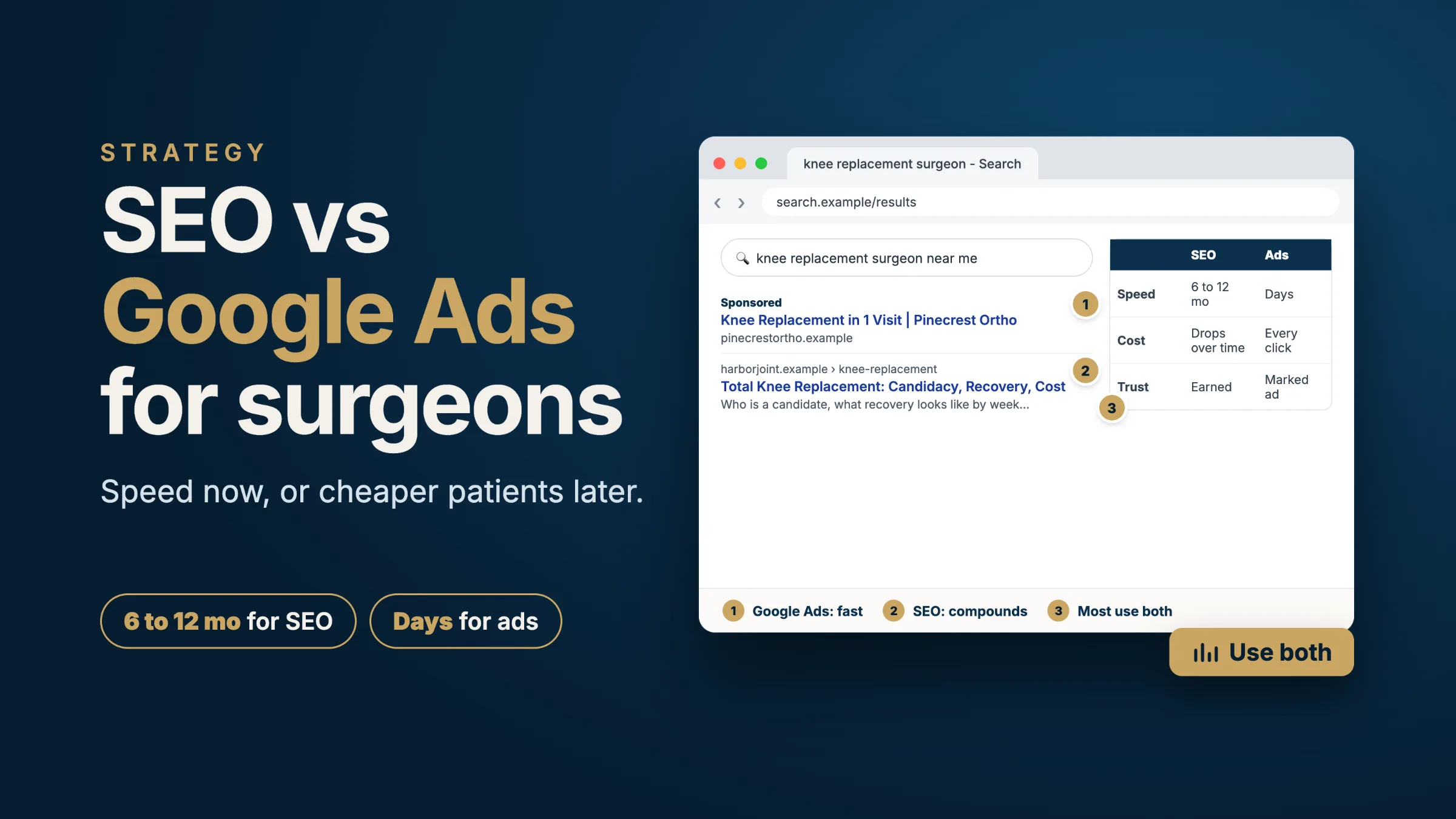
Done right, policy rarely stops a surgical campaign. For context on budget, see our breakdown of SEO vs Google Ads for surgeons.
Want a second opinion on your account? Get a free surgeon marketing audit and we'll flag policy risks, wasted spend and tracking gaps in a short video.
Frequently asked questions
Do surgeons need Google Ads healthcare certification?
Usually not. Google requires certification for online pharmacies, telemedicine that prescribes, addiction services, pharmaceutical manufacturers and health insurance. A practice advertising in-person surgical consultations does not fall into those groups, though bidding on prescription drug keywords does need certification.
Can I use remarketing for my surgical practice?
Not for surgical services. Google lists invasive medical procedures, including cosmetic surgery, as a sensitive health category, so remarketing lists, Customer Match, lookalikes and audience expansion are off the table. Google's own in-market and affinity audiences, location targeting and keywords still work.
Can I advertise Botox or other prescription treatments on Google?
In the US and Canada, Google now allows prescription drug terms in ads and landing pages if you follow local law, but keyword targeting those terms needs certification. In Canada, federal drug rules also limit consumer advertising of prescription drugs to name, price and quantity.
Can I show before-and-after photos in Google Ads?
Images showing nudity or partial nudity fall under Google's sexual content policy, which limits where and to whom they show, and they can't run on the Display Network or YouTube. Most practices keep ad creative clean and save results galleries for the landing page.
Do I need LegitScript if we prescribe GLP-1 weight loss medication?
If you prescribe or sell it online through telehealth, Google treats that as a prescription drug service and requires certification, which in the US means LegitScript accreditation. In-person prescribing as part of a bariatric program is a different case, but get the scope confirmed before launching.
The bottom line
For most surgical practices, Google Ads healthcare certification is a non-issue. The real rules to plan around are the sensitive-category targeting limits, drug term keywords, ad imagery and, in Canada, federal drug advertising law and your College's advertising policy. Build the account around those from the start and policy becomes a checklist, not a roadblock.
General information, not legal or medical advice. Rules change, so confirm anything compliance-related with your own advisor and your state board or provincial College.