
The medical website mistakes that cost surgeons the most patients are rarely about looks. They're slow mobile pages, phone numbers you can't tap, buried consultation buttons, thin procedure pages, long or non-compliant forms, inaccessible design and no tracking of what happens after someone inquires. Each one quietly turns interested patients into lost ones.
Why it matters: a surgical patient might spend weeks researching before they call. Your website is where they decide whether you're the surgeon they trust. If it's slow, vague or hard to use on a phone, they'll book with the practice down the road, and you'll never know they visited.
Wondering which of these your site has? Our free surgeon marketing audit checks speed, mobile booking, procedure pages and tracking, delivered as a short video.
Mistake 1: Is your site too slow on mobile?
If your pages miss Google's Core Web Vitals thresholds on phones, you're losing visitors before they read a word. Slow sites are the most common technical problem we find on surgical websites.
Google's Core Web Vitals define "good" as Largest Contentful Paint within 2.5 seconds, Interaction to Next Paint within 200 milliseconds and Cumulative Layout Shift of 0.1 or less, at the 75th percentile of real visits. The usual culprits on surgical sites: huge uncompressed before-and-after galleries, autoplay hero videos, a dozen marketing scripts and page builders loading code for features nobody uses.
Fix it: compress and lazy-load images, replace autoplay video with a poster image, remove unused plugins and scripts, and check real-user data in Google Search Console, not just a one-off lab test.
Mistake 2: Is it hard to call or book from a phone?
If a patient can't call or request a consultation in one tap from any page, you're adding friction at the exact moment they're ready. Phone calls are still the main way patients book.
In a Phreesia survey of about 14,000 patients, 65% preferred to schedule by phone and 18% online. Yet we regularly see phone numbers as images, numbers only in the footer, and "contact us" pages with a single generic form.
Fix it:
- Put a tappable phone number and a "request a consultation" button in a sticky mobile header.
- Repeat the consultation CTA after every major section of procedure pages.
- Offer online booking or a callback request for after-hours visitors.
- Make sure someone actually answers. Invoca's 2026 healthcare benchmarks found only 54% of callers to healthcare organizations reach a person.
Mistake 3: Are your procedure pages too thin?
A 300-word page that says "we offer rhinoplasty, call today" won't persuade patients or rank in Google. Procedure pages need to answer the questions patients ask before they'll book.
Google holds health content to a higher bar. Its guidance on creating helpful, reliable content stresses experience, expertise and trust, especially for topics that affect people's health. For a surgical procedure page, that means:
- Who's a good candidate and who isn't.
- What happens on surgery day, and a realistic recovery timeline.
- Risks, stated plainly.
- Cost guidance or what affects the price, plus financing.
- The surgeon's credentials and board certification, with a link to their bio.
- Real before-and-after photos with consent, where your board or College allows them.
- An FAQ section built from questions your consult team hears every week.
Our guide to procedure page SEO goes deeper on structure.
Mistake 4: Are your forms long, broken or non-compliant?
Forms fail in three ways: too many fields, no confirmation of what happens next, and tracking scripts that send health details to ad platforms. The third one is a legal risk, not just a conversion problem.
A consultation request only needs name, phone, email, procedure interest and preferred contact time. Medical history belongs in your intake process, not your marketing form. After submission, show a clear message: who will contact them and when.
On compliance: if your form asks about a procedure or condition, that submission is health information. Keep third-party pixels off form and booking pages, and use form and CRM tools that sign a business associate agreement. HHS guidance still treats tracking on pages where visitors share health details as covered, even after the 2024 court ruling on public pages. Our guide to HIPAA and PIPEDA compliant marketing covers the setup.
Mistake 5: Is your site inaccessible?
Most websites fail basic accessibility checks, and surgical sites are no exception. For many practices, accessibility is now a legal requirement.
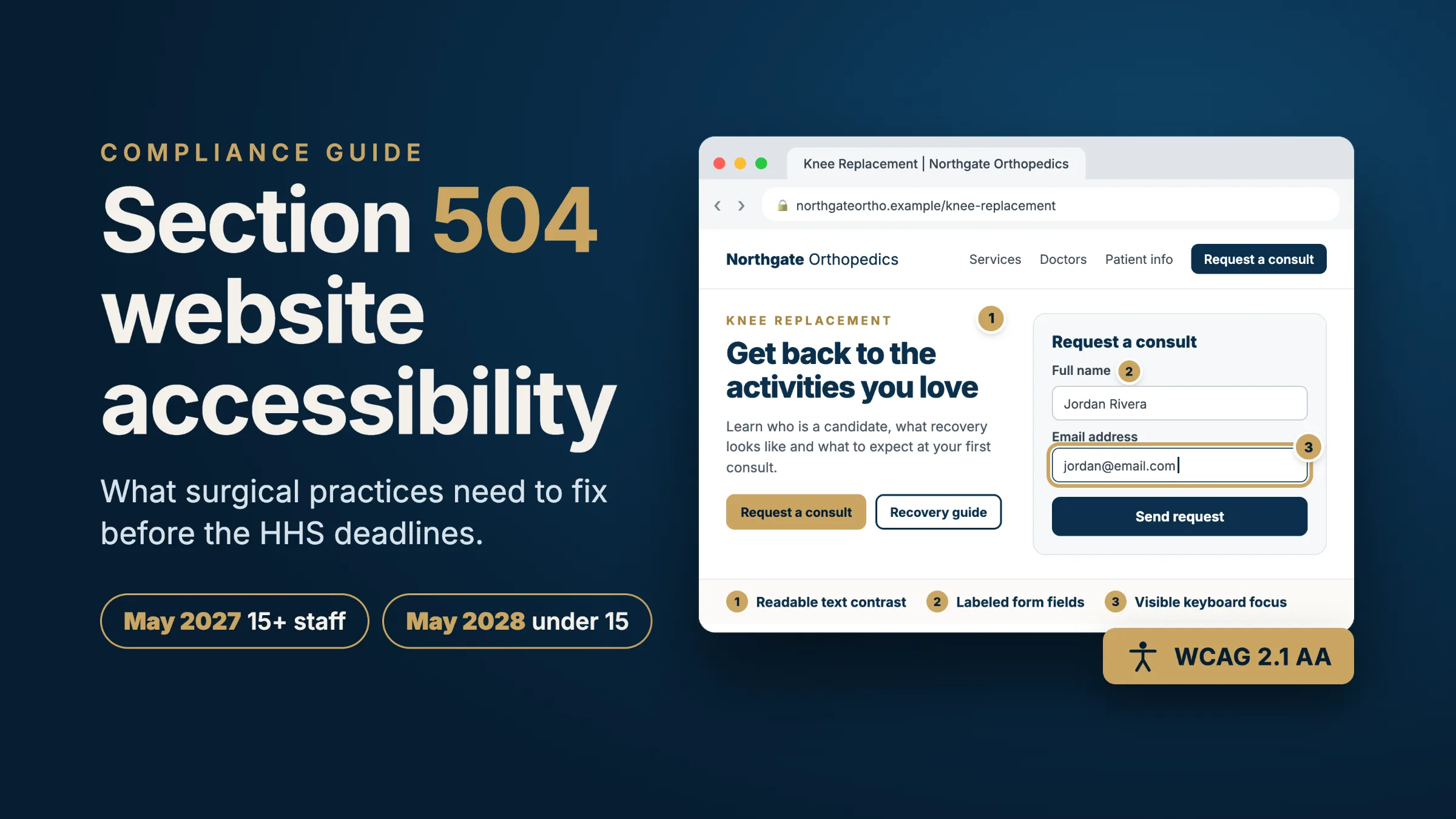
The 2026 WebAIM Million analysis of the top one million home pages found detectable WCAG failures on 95.9% of them, with low-contrast text on 83.9%. In the US, HHS's Section 504 rule requires recipients of HHS federal financial assistance to meet WCAG 2.1 AA. Many practices that bill Medicaid or other HHS programs fall in scope, so ask counsel whether yours does. HHS extended the deadlines in May 2026 to May 11, 2027 for recipients with 15 or more employees and May 10, 2028 for smaller ones. Lawsuits are a separate risk: UsableNet counted over 4,000 digital accessibility lawsuits in 2024.
Fix it: fix color contrast, add alt text to images, label every form field, make the site usable by keyboard and caption your videos. Overlay widgets don't make a site compliant on their own.
Mistake 6: Does your site hide who the surgeon is?
Patients choose a surgeon, not a logo. Sites that lead with stock photos and slogans instead of the surgeon's training, focus and approach lose the trust contest.
Show the surgeon's real photo, board certification, fellowship training, hospital affiliations and the procedures they focus on. Link each procedure page to the surgeon who performs it. Show real reviews from your Google Business Profile, and follow the rules: the FTC's 2024 rule on fake reviews and testimonials bans fake and bought reviews, and in Ontario the CPSO advertising policy bans patient testimonials in physician advertising altogether.
Mistake 7: Are you measuring clicks instead of consults?
If your reports stop at traffic and form fills, you can't tell which pages and channels bring patients. Many practices redesign a site based on looks when the real leak is after the inquiry.
Track calls and forms by source, record whether each inquiry booked, and calculate cost per booked consultation. We explain the metrics in what's a good conversion rate for a medical website.
Mistake 8: Is your website out of date or out of sync with Google?
Old surgeon bios, retired procedures, wrong hours or a different phone number from your Google Business Profile all chip away at trust. They also confuse Google about who you are and where you practice.
Google says local ranking depends on relevance, distance and prominence, and that complete, accurate business information helps. When your website lists one address, your profile another and an old directory a third, patients and Google both get mixed signals.
Fix it:
- Audit every location page: address, phone, hours and parking should match your Google Business Profile exactly.
- Remove or redirect pages for procedures you no longer offer, and update bios when surgeons join or leave.
- Put a "last reviewed" date on procedure pages and review them at least yearly with your clinical team.
- Check that the booking link, map embed and phone number work on every location page.
This is unglamorous work, but it's often the fastest trust and local SEO win available to a multi-location practice.
Which mistakes should you fix first?
Start with the fixes that are cheap and directly affect booking, then move to content and accessibility. Here's how we'd prioritize.
| Mistake | Impact on bookings | Effort | Fix first? |
|---|---|---|---|
| Hard to call or book on mobile | High | Low | Yes |
| Long or non-compliant forms | High | Low | Yes |
| No tracking past the form | High (hidden) | Low to medium | Yes |
| Slow mobile pages | Medium to high | Medium | Next |
| Thin procedure pages | High over time | Medium to high | Next |
| Surgeon hidden behind stock photos | Medium | Low | Next |
| Out-of-date info that doesn't match Google | Medium | Low | Next |
| Accessibility gaps | Medium, plus legal risk | Medium | Plan before your deadline |
Need a site that fixes all eight? See our website design for surgeons: fast, accessible, compliant and built to book consultations.
Frequently asked questions
What is the most common medical website mistake?
In our experience it's a weak path to booking on mobile: the phone number isn't tappable, the consultation button is buried, or the form is too long. Most surgical patients research on their phones, so every extra step costs inquiries.
How fast should a surgeon's website load?
Aim to meet Google's Core Web Vitals "good" thresholds: Largest Contentful Paint within 2.5 seconds, Interaction to Next Paint within 200 milliseconds and Cumulative Layout Shift of 0.1 or less, measured at the 75th percentile of real visits.
Do surgical practice websites need to be accessible?
Often, yes. Practices that receive HHS federal financial assistance must meet WCAG 2.1 AA under HHS's Section 504 rule, with deadlines currently in 2027 and 2028 depending on size. Accessibility lawsuits also hit private practices that take no federal funds.
Should procedure pages show prices?
You don't need exact quotes, but giving a typical range or explaining what affects cost removes a major reason patients leave without calling. Pair it with financing information if you offer it.
How often should a surgical website be redesigned?
There's no fixed cycle. Fix speed, mobile booking, content and tracking problems as you find them. A full rebuild makes sense when the platform can't support those fixes or the site no longer reflects the procedures you want to grow.
The bottom line
Your website doesn't need to win design awards. It needs to load fast on a phone, make calling or booking effortless, answer patients' real questions, keep their data safe, work for everyone and show you which pages bring consultations. Fix the cheap booking leaks this week, then work through content and accessibility.
General information, not legal or medical advice. Rules change, so confirm anything compliance-related with your own advisor and your state board or provincial College.