To get more bariatric surgery patients now, market the surgery as one part of obesity treatment rather than a competitor to GLP-1 drugs. Run online information seminars, publish clear insurance and eligibility content, speak honestly about medication versus surgery, and follow up through a long approval process. Bariatric patients take months to decide, so the program that stays helpful wins.
Why it matters: bariatric volume has dropped as GLP-1 medications have taken off, and patients now arrive with new questions. Programs that keep marketing the way they did in 2019 are seeing fewer seminar sign-ups. Programs that address medication directly, and help patients through insurance, are filling their calendars.
Is your seminar funnel leaking? Our bariatric surgeon marketing team will review it and send a free audit video in 2 business days.
How have GLP-1 drugs changed bariatric surgery demand?
US bariatric case volume has fallen since 2022, during the same period that GLP-1 use surged. The shift is real, but so is the opportunity: very few eligible patients get surgery, and many who start medication don't stay on it.
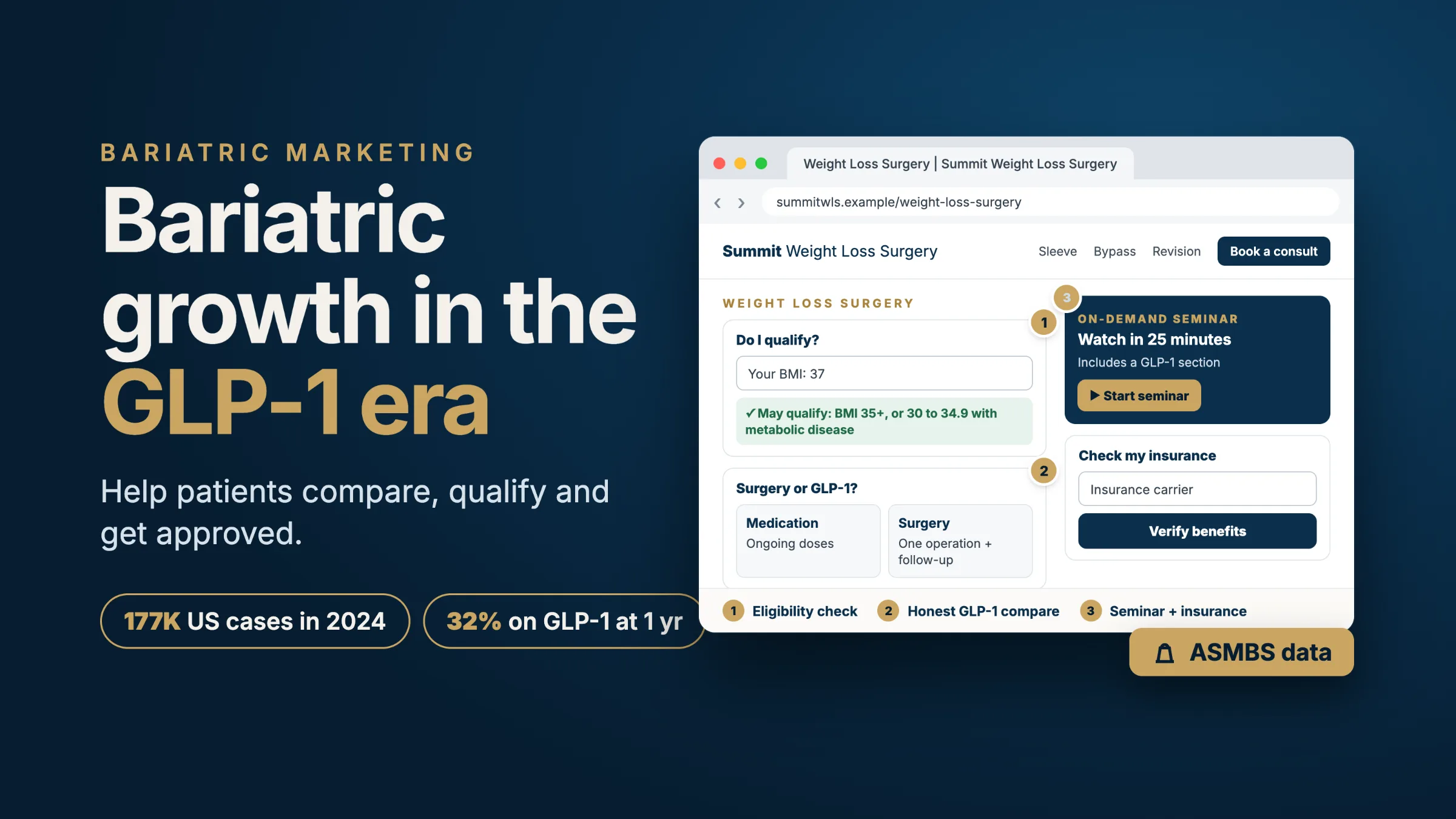
Research presented at the 2026 ASMBS annual meeting, using national MBSAQIP data, reported US cases of 230,207 in 2022, 217,387 in 2023 and 177,297 in 2024. The lead author linked the decline to high obesity rates and the surge in GLP-1 use, while noting the study did not test cause. ASMBS also notes that less than 1% of people eligible for metabolic and bariatric surgery have it in any given year.
Persistence on medication is the other half of the picture. Prime Therapeutics, a pharmacy benefit manager, tracked commercially insured adults with obesity and no diabetes who started GLP-1 therapy. Only 32% were still on it at one year, 15% at two years and 8.1% at three years.
The marketing takeaway: many future surgical patients are on, or have recently stopped, a GLP-1. Your content should meet them there.
Who qualifies for bariatric surgery today?
More people than many patients realize. The 2022 ASMBS and IFSO guidelines say surgery may be considered for anyone with a BMI above 35, and for people with a BMI of 30 to 34.9 who have metabolic disease, with lower thresholds for Asian populations.
Insurance is usually stricter than clinical guidelines. Medicare's national coverage determination covers bariatric surgery for beneficiaries with a BMI of at least 35, at least one obesity-related health condition, and previous unsuccessful medical treatment for obesity. Many commercial plans add their own steps, like supervised diet programs or psychological evaluation.
That gap between "may be considered" and "is covered" is where good marketing helps. Patients need to know if they qualify medically, if their insurance covers it, and what self-pay looks like if it doesn't.
What content do bariatric patients look for?
They want eligibility, insurance, cost, surgery types and real life after surgery. Medication comparisons are now near the top of that list.
| Patient question | Page or asset to build | Tip |
|---|---|---|
| Do I qualify? | BMI calculator plus eligibility explainer | Show guideline criteria and typical insurance criteria side by side |
| Will my insurance cover it? | Insurance page by major carrier, plus a verification form | Offer to check benefits for them; it is the biggest lead driver |
| What if I pay myself? | Self-pay price page with what is included | US self-pay patients are owed a good faith estimate |
| Surgery or GLP-1? | Honest comparison page | Cite sources and explain how they can be combined |
| Sleeve or bypass? | Procedure pages for each option | Cover reflux, diabetes and revision in plain language |
| What's life like after? | Support group, dietitian and long-term follow-up pages | Show the program, not just the operation |
How should you talk about GLP-1 drugs in your marketing?
Treat GLP-1 medication as part of the conversation, not the enemy. Patients trust a program that explains both options fairly more than one that dismisses medication.
A strong GLP-1 page covers:
- How medication and surgery differ in expected weight loss, duration and commitment, with linked sources.
- What happens if someone stops medication, and how many patients do stop.
- When surgery and medication are used together, including after surgery.
- Whether your program offers medical weight management alongside surgery.
Keep it compliant. Don't make guarantees about weight loss, avoid before-and-after photos that imply typical results without disclosure, and if your program sells GLP-1 prescriptions online, check Google's healthcare and medicines policy, since prescription telemedicine advertising can require certification.
Do bariatric seminars still work?
Yes. Online seminars are still one of the most reliable entry points into a bariatric program, as long as you make them short, on-demand and followed by quick personal outreach.
- Offer an on-demand seminar (20 to 30 minutes) alongside live sessions.
- Include a section on GLP-1 medication and how it fits.
- Ask two or three questions at sign-up: BMI range, insurance carrier, main goal.
- Call or text within minutes of seminar completion.
- Start insurance verification on that first call.
- Book the surgeon consult, then send a checklist of what the insurer needs.
Speed matters even in a slow-decision specialty. A Harvard Business Review study found firms contacting leads within an hour were about 7 times as likely to qualify them. See our guide on reducing consultation no-shows for the reminder sequence.
Which ads work for bariatric programs?
Google Search on surgery, cost and insurance terms is the core. Expand to "weight loss surgery vs Ozempic" style queries, since patients are searching that comparison now.
Google's personalized advertising policy treats invasive medical procedures as a sensitive interest category, so you can't use remarketing lists, Customer Match or lookalikes for surgical services. Build campaigns that convert on the first visit: one for seminars, one for insurance, one for self-pay, and one for revision surgery. Keep landing pages fast, mobile-first, and focused on a single action.
Privacy matters too. Bariatric forms collect health data, like BMI and conditions. Keep tracking off logged-in patient portal pages, which are still covered by HHS tracking guidance, and use a HIPAA-ready form and CRM. Our HIPAA-compliant marketing guide covers the setup.
How do you build referrals from other physicians?
Make it easy for primary care doctors and endocrinologists to send the right patients, and close the loop when they do. Referrals are often the highest-converting source a bariatric program has, and GLP-1 prescribing has put more obesity conversations in those offices.
- Give referrers a one-page summary of current eligibility guidelines, typical insurance criteria and your program's steps, so they can set expectations.
- Offer a simple referral path: one fax number or e-referral link, and a promise to contact the patient within one business day.
- Send a short update to the referring physician after the consult and after surgery. Doctors keep referring to programs that keep them informed.
- Position your medical weight management as a place to send patients who are struggling with, or stopping, GLP-1 therapy.
Should you market revision surgery separately?
Yes. Revision patients search differently, often for reflux after sleeve gastrectomy, weight regain or a band that never worked, and they need their own page and campaign.
The ASMBS research shows the procedure mix shifting, with gastric bypass rising from about 28% of cases in 2020 to about 33% in 2024 as sleeve share fell. Patients with a prior sleeve and reflux are a real, specific audience. Write in plain language about symptoms, options and insurance, and make it easy to send prior surgical records before the consult.
How is bariatric marketing different in Canada?
In Canada, the barrier is usually wait time, not insurance approval. Most bariatric surgery is publicly funded through provincial programs.
Obesity Canada's 2019 Report Card on Access to Obesity Treatment found waits from referral to surgical consult ranged from 18 to 106 months, and gave every province offering surgery except Quebec an F on access. Private programs market speed, continuity and support, and must make clear which services are private-pay. Advertising follows provincial College rules, so testimonials are banned in physician ads in Ontario. CASL covers commercial emails and texts, and Quebec's Law 25 adds strict consent rules.
Want to see how your program shows up for patients comparing surgery and medication? Get a free surgeon marketing audit, delivered as a short video in 2 business days.
Frequently asked questions
Are GLP-1 drugs reducing bariatric surgery volume?
Volume has fallen. Research presented at the 2026 ASMBS meeting found US cases fell from 230,207 in 2022 to 177,297 in 2024, alongside a surge in GLP-1 use, though the authors noted the study did not prove cause. Many programs now market surgery and medication as options that can work together.
Who qualifies for bariatric surgery?
The 2022 ASMBS and IFSO guidelines say surgery may be considered for anyone with a BMI above 35, and for people with a BMI of 30 to 34.9 who have metabolic disease. Insurance criteria are often stricter; Medicare, for example, requires a BMI of at least 35, a related health condition and previous unsuccessful medical treatment.
What is the best lead source for bariatric programs?
Online information seminars, supported by search ads and SEO for surgery, cost and insurance terms, are a proven entry point. Referrals from primary care and endocrinology matter too, especially for patients who have tried GLP-1 medication.
Should bariatric practices talk about GLP-1 drugs in their marketing?
Yes, honestly. Patients are already asking about them. Explain how medication and surgery compare, when they can be combined, and what happens if someone stops medication, using sourced data and without dismissing either option.
How is bariatric marketing different in Canada?
Most bariatric surgery in Canada is publicly funded, so waits are the main barrier rather than insurance approval. Obesity Canada's 2019 report card found waits from referral to surgical consult ranged from 18 to 106 months. Private programs market speed and support, and must follow provincial College advertising rules.
The bottom line
Bariatric marketing has to change with the GLP-1 era, not fight it. Explain eligibility and insurance clearly, compare surgery and medication honestly, keep your seminar funnel short and fast, and stay with patients through a long approval process. The programs that teach best will get the patients who are ready for surgery.
General information, not legal or medical advice. Rules change, so confirm anything compliance-related with your own advisor and your state board or provincial College.