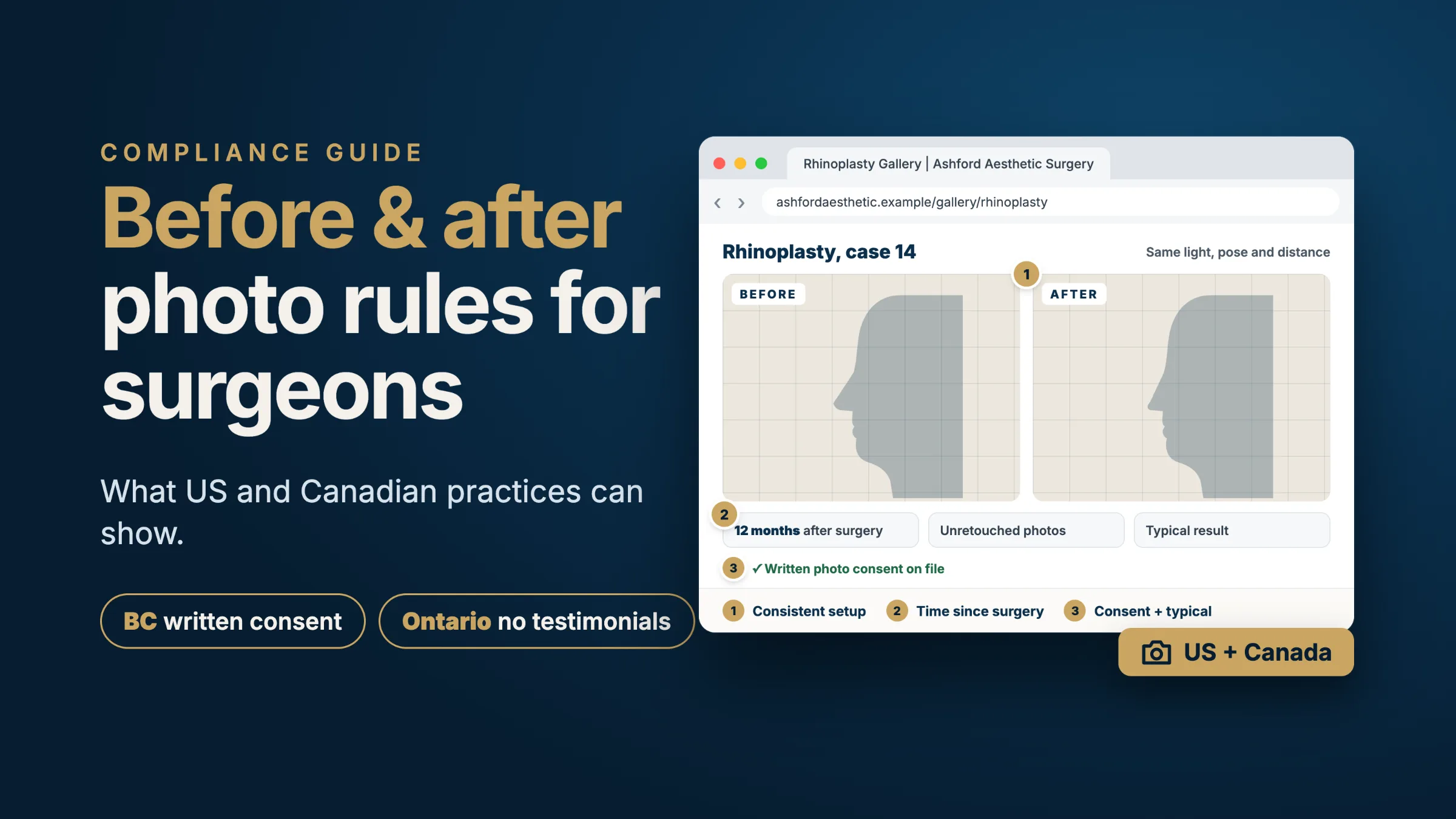

Canadian plastic surgeons can advertise, but each province's college sets the rules, and they're stricter than most US practices are used to. Ontario and Alberta ban patient testimonials. All three of Ontario, BC and Alberta require consent for before-and-after photos. BC and Alberta ban discounts and inducements outright. The physician is responsible for every ad, even one an agency writes.
Cosmetic surgery is where these rules get tested most, because it's the part of medicine that looks the most like retail. This guide compares the three provinces where most of our Canadian plastic surgery conversations happen, with a short note on Quebec. It's general information, not legal advice, so check the current version of your own college's standard before you publish.
Who regulates plastic surgery advertising in Canada?
Each provincial college of physicians and surgeons. There's no single national rulebook for physician advertising, so a practice with clinics in two provinces has to follow two sets of rules.
- Ontario: the College of Physicians and Surgeons of Ontario (CPSO) and its Advertising policy.
- British Columbia: the College of Physicians and Surgeons of BC (CPSBC) and its Advertising and Communication with the Public practice standard, last revised in June 2026.
- Alberta: the College of Physicians and Surgeons of Alberta (CPSA) and its Advertising standard of practice.
General consumer law applies on top of that. Canada's Competition Act prohibits false or misleading representations in any advertising, medical or not.
How do the rules compare across Ontario, BC and Alberta?
Here's the short version. The details below the table matter, so don't stop here.
| Rule | Ontario (CPSO) | British Columbia (CPSBC) | Alberta (CPSA) |
|---|---|---|---|
| Patient testimonials | Not allowed | Not named, but no unreasonable expectations or guarantees | Not allowed (no claims, endorsements or testimonials) |
| Before-and-after photos | Allowed with detailed conditions and consent | Only with written patient consent | Written consent to use identifying features |
| Discounts and time-limited offers | Not addressed directly; no sensational or misleading ads | Not allowed | Not allowed |
| Gifts, prizes, gift certificates | No incentives for photo consent | Not allowed | Not allowed (also parties and makeovers) |
| Comparisons or "best" claims | Not allowed | Not allowed | Only if substantiated; no disparaging others |
| Other notable rules | Photos need a "not guaranteed" statement | "Surgeon" limited to RCPSC-certified specialists for cosmetic ads; must say what MSP doesn't cover | No guarantees or unreasonable expectations |
Can you use patient testimonials and reviews?
Not in your advertising in Ontario or Alberta. The CPSO policy says physicians must not use testimonials, and the CPSA standard says advertising must not include claims, endorsements or testimonials. BC's standard doesn't name testimonials, but it does bar ads that create unreasonable expectations or guarantee results, and a glowing patient quote does exactly that.
What about Google reviews? Patients are free to leave them, and you can respond politely without sharing any health information. The risk comes when you take those reviews and put them into your own ads, website banners or social posts. That turns a patient's review into your testimonial.
A practical rule for Canadian clinics: let reviews live where patients wrote them. Link to your Google profile if you like, but don't copy patient quotes into ads, landing pages or Instagram graphics.
What are the rules for before-and-after photos?
Ontario's are the most detailed. Under the CPSO policy, before-and-after photos have to:
- be accurate and educational, and show typical results rather than your single best case;
- show an actual patient of the physician advertising the procedure;
- be unaltered, with the same lighting, pose and background in both shots;
- be de-identified unless the patient consents otherwise;
- carry a statement that results are not guaranteed and may vary between patients.
The CPSO also limits where they appear. Photos belong where patients go looking for them, such as your website, rather than in unsolicited ads like newspaper or magazine placements. Consent has its own conditions: it should be given after the procedure, once the patient has seen the final images, with the risks explained, no incentive offered and the right to withdraw it.
BC requires written consent before any before-and-after photo is used, and the college can ask to see that consent. If you use models rather than patients, the image must say so. Alberta requires written consent before using a patient's name or identifying features.
We cover the US side and the practical workflow in our guide to before-and-after photo rules.
Can you run promotions, discounts or giveaways?
This is where US-style cosmetic marketing breaks Canadian rules most often. The BC standard bars inducements such as prizes, gifts and gift certificates, and discounts or time-limited benefits for medical services. Alberta's standard lists time-limited prices, coupons, gift certificates, prizes, parties and makeovers as prohibited inducements.
That rules out a lot of common tactics: "20% off tummy tucks this month", contest giveaways on Instagram, refer-a-friend credits and free-filler-with-surgery bundles. Ontario's policy doesn't address promotions directly, but it bans sensational or misleading advertising and any incentive for photo consent (which it notes is often a discount). The safe approach in all three provinces is the same. Market the procedure, the surgeon and the process, not the price.
Who can call themselves a cosmetic surgeon?
In BC, the rule is specific. The CPSBC standard says the word "surgeon" can't be used in advertising for cosmetic procedures unless the physician is a Royal College of Physicians and Surgeons of Canada certified specialist in a relevant surgical discipline. A family physician offering cosmetic procedures can't advertise as a "cosmetic surgeon".
BC ads must also state clearly which services are not covered by the Medical Services Plan. For a cosmetic practice, that's most of the menu, so build the statement into your page templates.
In every province, keep credentials accurate. Use the exact certification name, list fellowships correctly and don't imply a specialty you don't hold.
Do the same rules apply on Instagram and TikTok?
Yes. The BC standard defines advertising to include communications through electronic media and the internet, and the Ontario and Alberta rules apply to advertising in any medium. Your practice Instagram, Reels, TikToks, YouTube videos and paid social ads all count.
Social is also where rules slip, because posts go out fast and often. A before-and-after carousel without the Ontario disclaimer, a patient's thank-you message reposted as a story or a holiday giveaway are all common problems. Our Instagram guide for plastic surgeons covers formats that work within these limits.
Who is responsible when an agency runs your ads?
You are. The CPSO policy makes physicians responsible for advertising done on their behalf, and the other colleges take the same position. If your agency, clinic manager or a booking platform publishes something non-compliant under your name, the complaint lands on your licence.
That's why we build approval into every campaign we run for Canadian surgeons:
- Every ad, landing page and social post gets the physician's sign-off before it goes live.
- Photo consent forms are stored with the image and checked before reuse.
- Ontario photos carry the results statement in the image or caption.
- BC pages include the MSP coverage statement.
- No discounts, giveaways or patient quotes in paid ads.
Rules change. The CPSBC standard was revised as recently as June 2026. Read the current version of your college's standard at least once a year, and again before any big campaign. General information, not legal advice.
What about Quebec and other provinces?
Quebec physicians follow the Code of ethics of physicians, enforced by the Collège des médecins du Québec, which also restricts misleading and comparative advertising. Commercial advertising in Quebec also has to meet French-language requirements. Practices in other provinces should check their own college's standard, as the rules differ in detail even where the principles match.
Frequently asked questions
Can plastic surgeons in Canada use patient testimonials?
In Ontario and Alberta, no. The CPSO Advertising policy and the CPSA Advertising standard both prohibit testimonials in physician advertising. The BC standard does not name testimonials, but it bans ads that create unreasonable expectations or imply superiority, so most BC practices avoid them too. Check your own college before publishing any patient quote.
Are before-and-after photos allowed in Canada?
Yes, with conditions that vary by province. All three colleges require proper patient consent. Ontario adds the most detail: photos must be accurate, unaltered, of your own patients, shot in consistent conditions, and carry a statement that results are not guaranteed and may vary between patients.
Can I offer discounts or promotions on cosmetic surgery in Canada?
Generally not in BC or Alberta. The CPSBC standard bans discounts, time-limited benefits and inducements like gifts and gift certificates, and the CPSA standard bans time-limited prices, coupons, prizes, parties and makeovers. The Ontario policy does not address price promotions directly, but it bans sensational advertising and incentives for photo consent, so price-led promotions carry risk everywhere.
Who is responsible if my marketing agency breaks the rules?
You are. Provincial colleges hold the physician responsible for advertising placed on their behalf, including ads written or run by an agency or a clinic. Approve every ad, social post and landing page before it goes live, and keep records of patient consent.
Do these rules apply to Instagram and TikTok?
Yes. Physician advertising rules cover communications through electronic media and the internet, which includes your website, social media accounts, paid social ads and videos. A post on your practice Instagram is held to the same standard as a print ad.
The bottom line
Canadian plastic surgery marketing works best when it sells trust, not deals. Skip testimonials and discounts, get written consent for every photo, follow your province's photo and wording rules to the letter, and approve everything that goes out under your name. Our plastic surgeon marketing work is built around these rules for Canadian clinics. Not sure where your current ads stand? Request a free practice growth audit and we'll flag the risks.
General information, not legal or medical advice. Rules change, so confirm anything compliance-related with your own advisor and your state board or provincial College.